Section 3.3 Properties Of Arithmetic Operations

Subsection 3.3.1 Order Of Operations

A quick reminder about the order of operations that occur in an expression. These have been universally agreed upon over time, so we should make sure we’re comfortable with this.
  1. Perform operations inside of brackets (using the ordering we are listing) in the order they occur, left to right.
  2. Perform exponential and root operations in the order they occur, left to right.
  3. Perform divisions and multiplications in the order they occur, left to right.
  4. Perform addition and subtraction in the order they occur, left to right.
You have probably heard the expression BEDMAS as a reminder of the order. More precisely, it should read BE(DM)(AS), as we think of division and multiplication, and addition and subtraction, as pairs of the same operations (as each member of the pair is the inverse operation of the other member.)

Example 3.3.1.

Be careful when you see expressions like \(3+4(5-2)\text{.}\) It is a very common error to add the \(3+4\) first, which is incorrect as it does not follow our order of operations. Of course, we should have
\begin{equation*} 3+4(5-2) = 3+4(3) = 3+12 = 15. \end{equation*}

Subsection 3.3.2 Properties Of Arithmetic

There are some important properties of arithmetic operations that are worth pointing out and discussing. We use them regularly, and we will rely on them especially in the coming section on algorithms for arithmetic. Let’s use the symbol \(\square \) to mean any one of our arithmetic operations. Note that we can think of all of our operations *combining* two numbers to make another number.

Definition 3.3.2.

Closure - We say a set \(S\) is closed under the operation \(\square\) exactly when it’s the case that if both \(a,b \in S\) then \((a \square b) \in S\text{.}\)
Example 3.3.3.
Since addition of two whole numbers gives us another whole number, we have that the set \(\mathbb{N}_0\) is closed under \(+\text{.}\) Similarly, \(\mathbb{N}_0\) is closed under \(\times\) as well. However, \(\mathbb{N}_0\) is *not* closed under subtraction, since (as a counterexample to the if-then statement in the definition of closure) \(2-4 = (-2)\text{.}\) We know that \(2,4 \in \mathbb{N}_0\) (so the if part of the definition is true) but \((-2) \notin \mathbb{N}_0\) (so the then part of the definition is false).

Definition 3.3.4.

We say an operation \(\square\) is commutative exactly when it’s the case that when \(a \square b=c\) then \(b \square a=c\text{;}\) that is, \(a \square b = b \square a\) (order of performing the operation doesn’t matter).
Example 3.3.5.
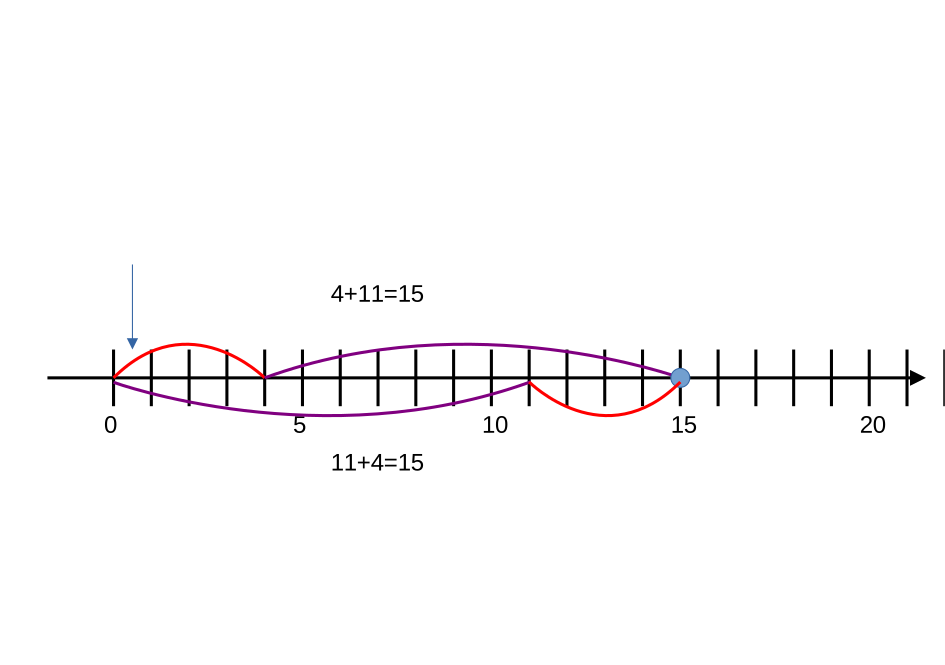
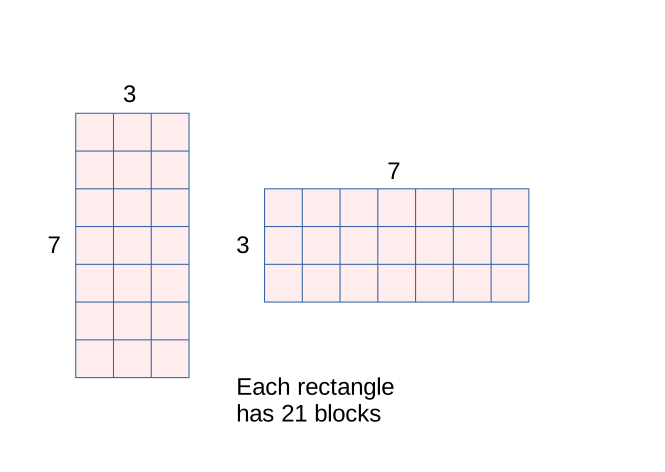
In \(\mathbb{N}\text{,}\) addition and multiplication are commutative. For example, \(4+11 = 11+4\) and \(3 \times 7 = 7 \times 3\text{.}\) We can view these pictorially:
Let’s move to the set \(\mathbb{Z}\) so that subtraction is closed and our subtractions make sense. Subtraction is *not* a commutative operation since, as a counterexample, \(3-2=1\) but \(2-3=(-1)\text{.}\) Similarly, division in the set \(\mathbb{Q}\) is not commutative.

Definition 3.3.6.

We say an operation \(\square\) is associative exactly when it’s the case that when \((a \square b) \square c =d\) then \(a (\square b \square c) =d\text{;}\) that is, \((a \square b) \square c = a\square (b \square c)\) (grouping performing the operation doesn’t matter).
Example 3.3.7.
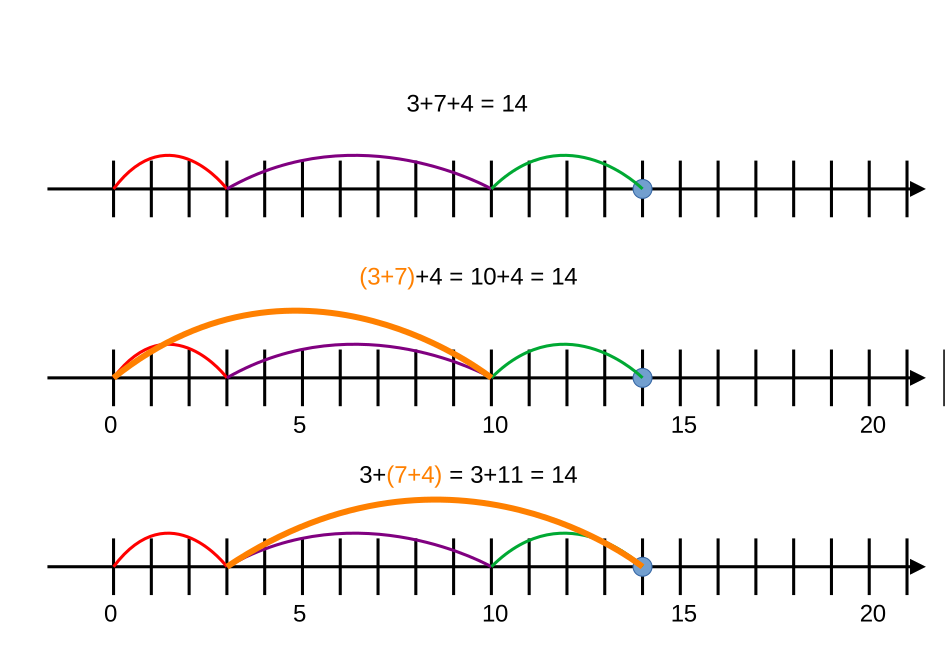
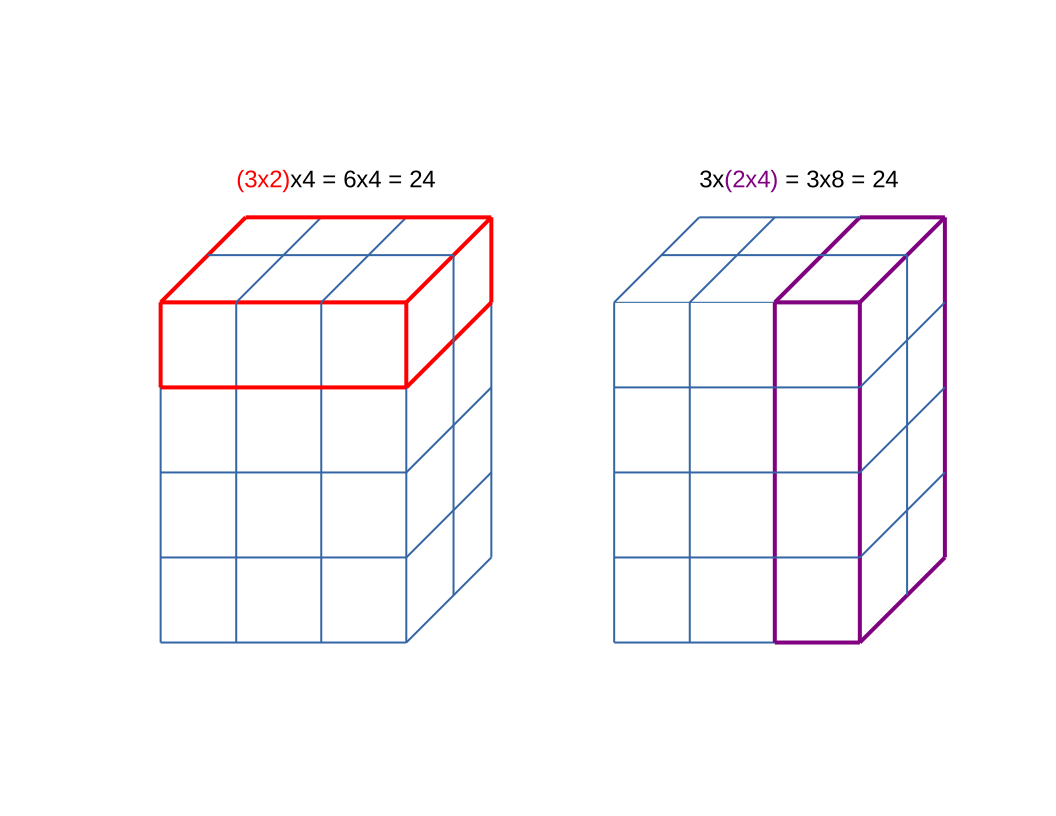
In \(\mathbb{N}\text{,}\) addition and multiplication are associative. For example, \((3 \times 2) \times 4 = 3 \times (2 \times 4)\) and \((3 + 7)+4 = 3+ (7 +4)\text{.}\) We can view these pictorially:
Now in \(\mathbb{N},\) subtraction is *not* associative. As a counterexample, we have \((6-4)-1 = 2-1 =1\) but \(6-(4-1) = 6-3 = 3\text{.}\)
Using associativity and distributivity can help us do arithmetic more quickly and easily. For example, if we were to add \(7+5+11+4+8+3,\) we can look for pairs (or triples, etc) of numbers that sum to a multiple of ten. Using associativity and commutativity we can rearrange the above to
\begin{equation*} 7+5+11+4+8+3 = (7+3) + (11+5+4) + 8 = 10 +20 +8 = 38 \end{equation*}
Similarly for multiplication, we can look for number that multiply together to give a power of ten. This will make our multiplication much easier. For example, if we were to multiply \(4 \times 7 \times 5 \times 15\) we could use associativity and commutativity to rearrange to above to
\begin{equation*} \end{equation*}
\begin{equation*} = 20 \times 7 \times 15 = (20 \times 15) \times 7 \end{equation*}
\begin{equation*} =300 \times 7 = 2100. \end{equation*}
Now we talk about properties specific to addition/subtraction and multiplication/division.

Definition 3.3.8.

We call 0 the additive identity since \(a+0=a\) for any number \(a\text{.}\)

Definition 3.3.9.

We call 1 the multiplicative identity since \(a \times 1 = a\) for any number \(a\text{.}\)
Using the idea of identities, we can talk about inverse elements for each pair of related operations. In later sections when we discuss integers and rational numbers, we will talk about how we can turn every subtraction problem into an addition problem, and (almost) every division problem into a multiplication problem. In this sense, we can think of subtraction as being the "same" operation as addition, and division being the "same" operation as multiplication.

Definition 3.3.10.

Let \(a\) be a number. Then \(b\) is the additive inverse or negative of \(a\) if and only if \(a+b=0\text{.}\)
Example 3.3.11.
In the set of integers, \((-2)\) is the negative of \(2\) since \((-2)+2=0\text{.}\) This also means that \(2\) is the negative of \((-2)\text{.}\)
Example 3.3.12.
However, \(2\) has no negative in the set of whole numbers, since there is no \(b \in \mathbb{N}_0\) such that \(2+b=0\text{.}\) So depending on the set you are working with, negatives may or may not exist.

Definition 3.3.13.

Let \(a\) be a number. Then \(b\) is the multiplicative inverse or reciprocal of \(a\) if and only if \(a \times b = 1\text{.}\)
Example 3.3.14.
In the set of rational numbers, or fractions, \(\frac{1}{5}\) is the reciprocal of \(5\) since \(\frac{1}{5} \times 5 = 1\text{.}\) This also means that \(5\) is the reciprocal of \(\frac{1}{5}\text{.}\)
Example 3.3.15.
Note that in any set, \(0\) does not have a reciprocal, since there is no number \(b\) such that \(0 \times b = 1\) since we know that \(0 \times b = 0\) for any choice of \(b\) (of course, we know this fact is true, but we will carefully show *why* it is true later in this section.)
The last property we will discuss involves how multiplication and addition "play" together.

Definition 3.3.16.

Let \(a,b,c\) be numbers. Then we call the property that \(a \times (b+c) = a\times b + a\times c\) the distributive property.
Example 3.3.17.
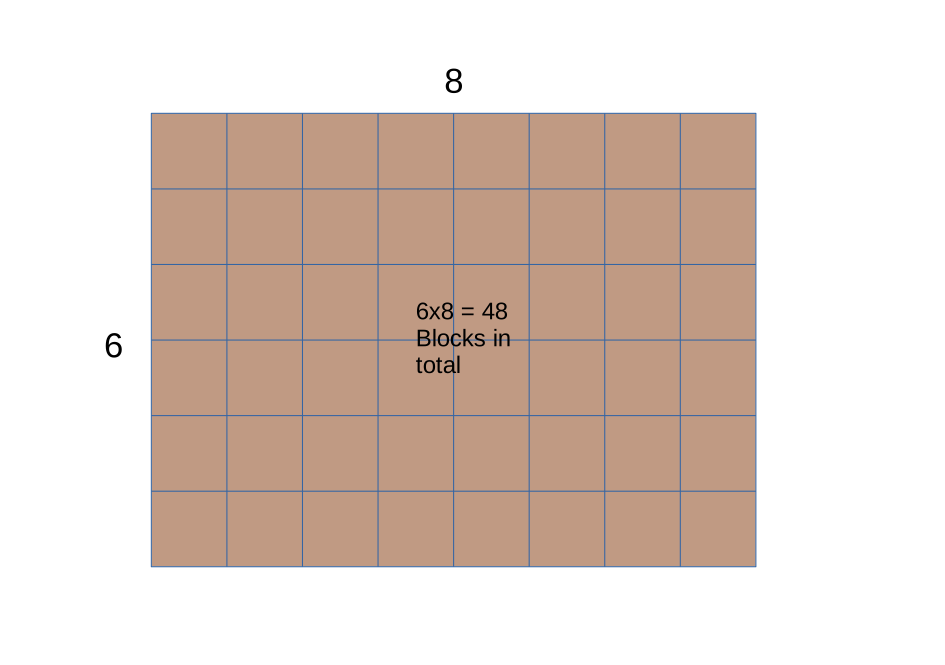
The easiest way to view why distributivity holds is via a picture using the array model of multiplication. Consider a chocolate bar that measures \(6\) blocks vertically and \(8\) blocks horizontally. In total, the chocolate bar has \(6 \times 8 = 48\) blocks:
Now, let’s "break" this chocolate bar between the 3rd and 4th horizontal block thus giving us 3 blocks horizontally in the first section and 5 in the second (of course, we still have the same amount of chocolate). So we can view this now as \(6 \times (3+5)=48\text{.}\) But we could calculate the number of blocks separately in each of the two sections, and then add them together. Obviously we would still have the same amount of chocolate. So there are \(6 \times 3+ 6 \times 5 = 18 + 30 = 48\) blocks of chocolate.
This idea represents the idea behind distributivity. Note that distributivity is *very* important when we start discussing methods for multiplying in a later section.
Note that we can extend the idea in the previous example to any number of "cuts" in our chocolate bar. We could show this more formally, but the following examples should give an idea of how this works

Example 3.3.18.

Let’s look at \(6 \times 8\) again. We can break \(8\) into \(2+4\text{,}\) and \(8\) into \(3+5\text{.}\) Thus we can view \(6 \times 8\) as \((2+4) \times (3+5)\text{.}\) Viewed as a chocolate bar as in the previous example:
We can now multiply the constituent parts and the add them together to obtain the final answer. Note that we multiply each number in the first bracket by each number in the second. So
\begin{equation*} 6 \times 8 = (2+4) \times (3+5) \end{equation*}
\begin{equation*} = 2 \times 3 + 2 \times 5 + 4 \times 3 + 4 \times 5 \end{equation*}
\begin{equation*} = 6+10+12+20 = 48 \text{.} \end{equation*}

Example 3.3.19.

Example 3.3.20.

Let’s use the same idea to multiply \(237 \times 841\text{.}\) We can split each number in terms of its place values: \((200+30+7) \times (800 \times 40 \times 1)\text{.}\) Using the same idea as the previous examples we can view this as
\begin{equation*} 200 \times 800 + 200 \times 40 + 200 \times 1 \end{equation*}
\begin{equation*} + 30 \times 800 + 30 \times 40 + 30 \times 1 \end{equation*}
\begin{equation*} + 7 \times 800 + 7 \times 40 + 7 \times 1 \end{equation*}
\begin{equation*} = 160000 + 8000 + 200 \end{equation*}
\begin{equation*} +24000 + 1200 + 30 \end{equation*}
\begin{equation*} +5600 + 280 + 7 \end{equation*}
\begin{equation*} =199317 \end{equation*}

Notes For Additional Understanding.

It is just beyond the scope of this textbook, but we could show that the above properties *must* hold for addition and multiplication using a proving technique called mathematical induction for many of these. We will eventually prove that \(a \times 0 = 0\) for all numbers \(a\) which is usually called the property of multiplication by zero.
We can use these properties to carefully show some results about arithmetic. We will do one, and leave the others as an exercise for you.

Subsection 3.3.3 Consequences of Properties

Subsubsection 3.3.3.1 Related Subtraction and Division Problems

Using the definitions of subtraction and division (in terms of addition and multiplication, respectively) and the property of commutativity, if we know the answer to one subtraction or division problem (with a remainder of \(0\)), we know the answer to another related subtraction or division problem.
Let’s explore this with a few examples first (which is always a good idea), and then we can think about what is happening in general.
Example 3.3.21.
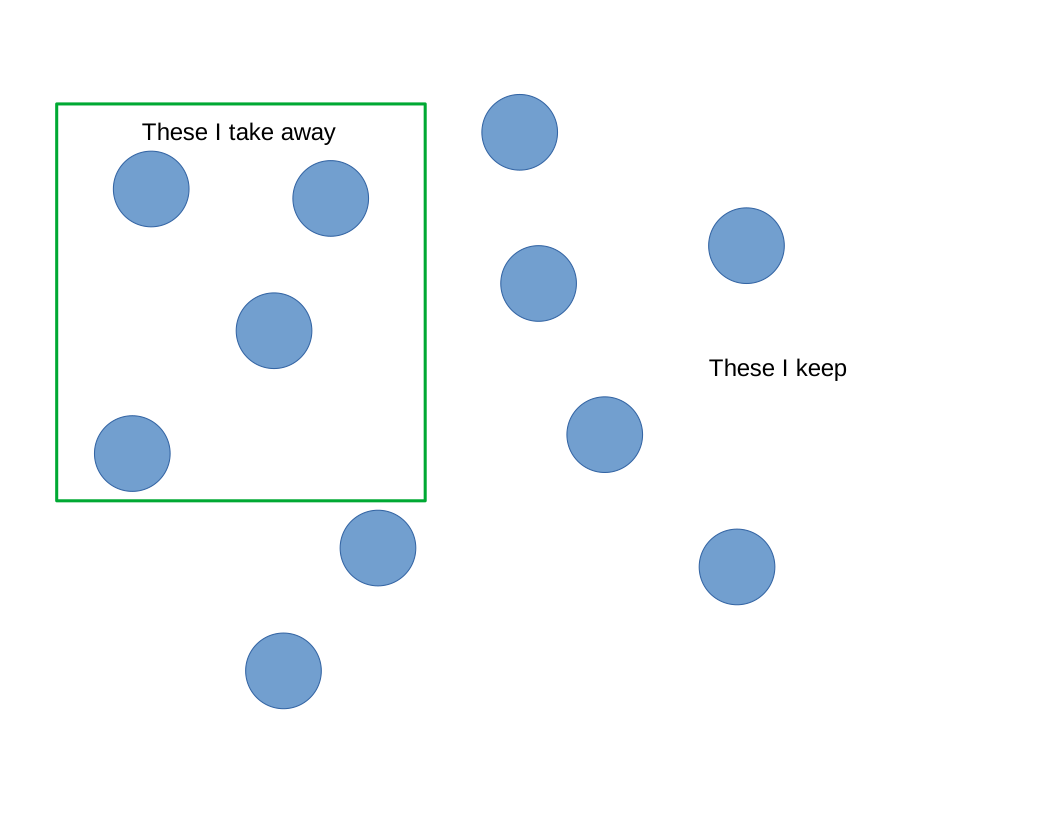
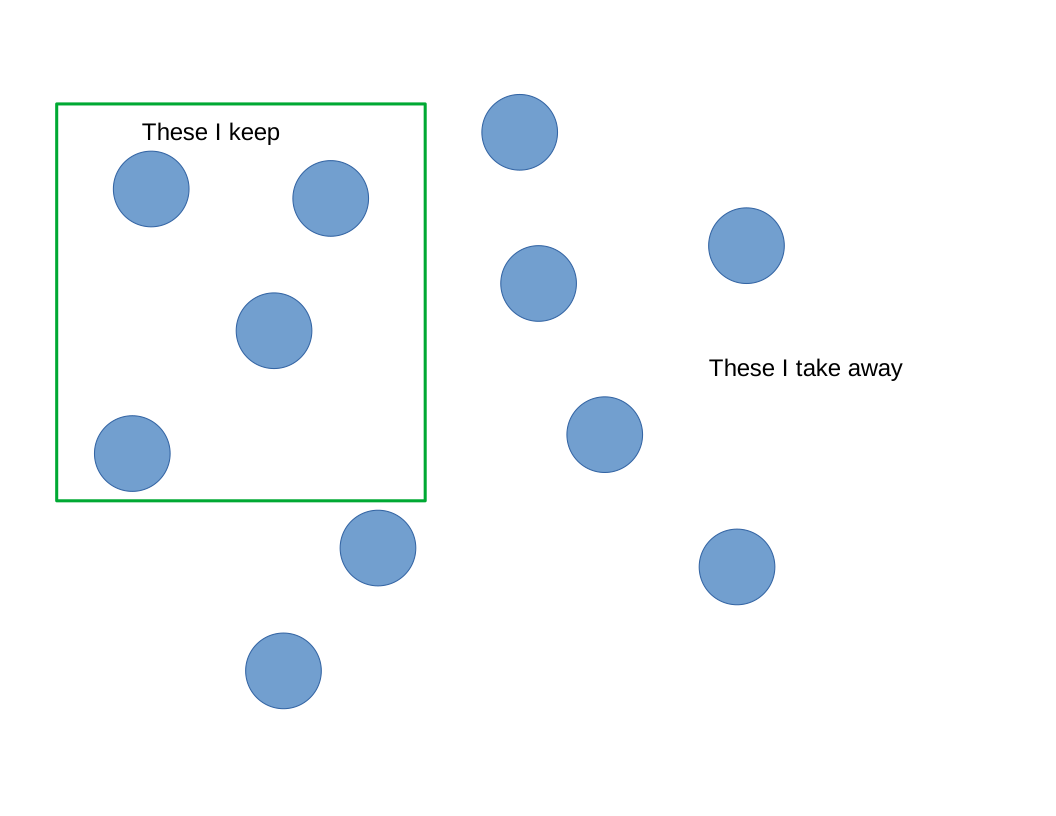
Consider the subtraction problem \(11-4=7\text{.}\) Intuitively, we are taking away \(4\) from \(11\) to leave \(7\text{.}\) However, there is no real difference between the ideas of "taking away" and "leaving". We’re simply separating \(11\) into two groups; one of size \(4\) and one of size \(7\text{.}\)
So \(4\) and \(7\) are playing similar roles here. We can see this in the definition of addition: we know
\begin{equation*} 11-4 = 7 \end{equation*}
since \(7\) is the number such that \(11 = 4+7\text{.}\) However, we can use the idea of commutativity to swap the \(4\) and \(7\text{:}\)
\begin{equation*} 11=7+4 \end{equation*}
and thus \(4\) can be viewed as the number, when added to \(7\text{,}\) to have a sum of \(11\text{.}\) This is the definition of the subtraction problem
\begin{equation*} 11-7=4. \end{equation*}
So we have two related subtraction problems, \(11-4=7\) and \(11-7=4\text{.}\)
Example 3.3.22.
Now consider the division problem \(15 \div 5 = 3\text{.}\) This means that \(3\) is the number such that
\begin{equation*} 15 = 3 \times 5 \end{equation*}
(note there is no remainder here so we don’t have to worry about that part of division). Like the previous example, we can use commutativity to swap the \(3\) and \(5\text{:}\)
\begin{equation*} 15 = 5 \times 3. \end{equation*}
Thus we can view \(5\) as the number, when multiplied by \(3\text{,}\) to give you a product of \(15\) and thus
\begin{equation*} 15 \div 3 = 5. \end{equation*}
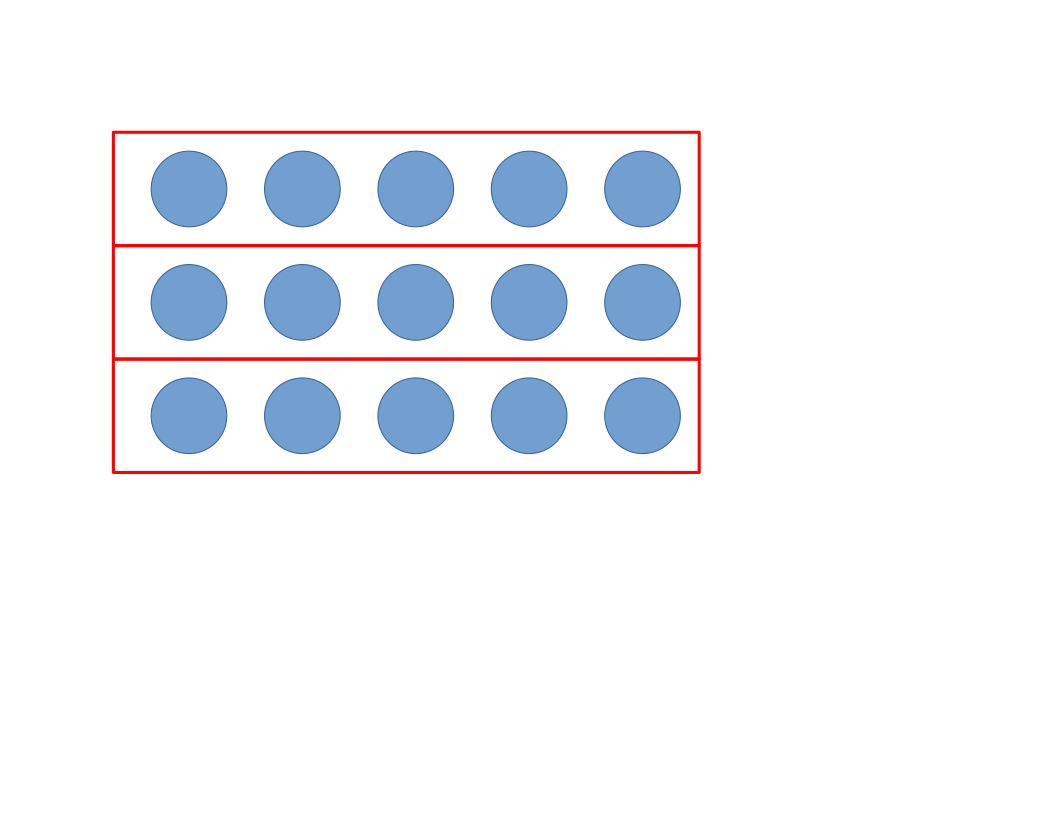
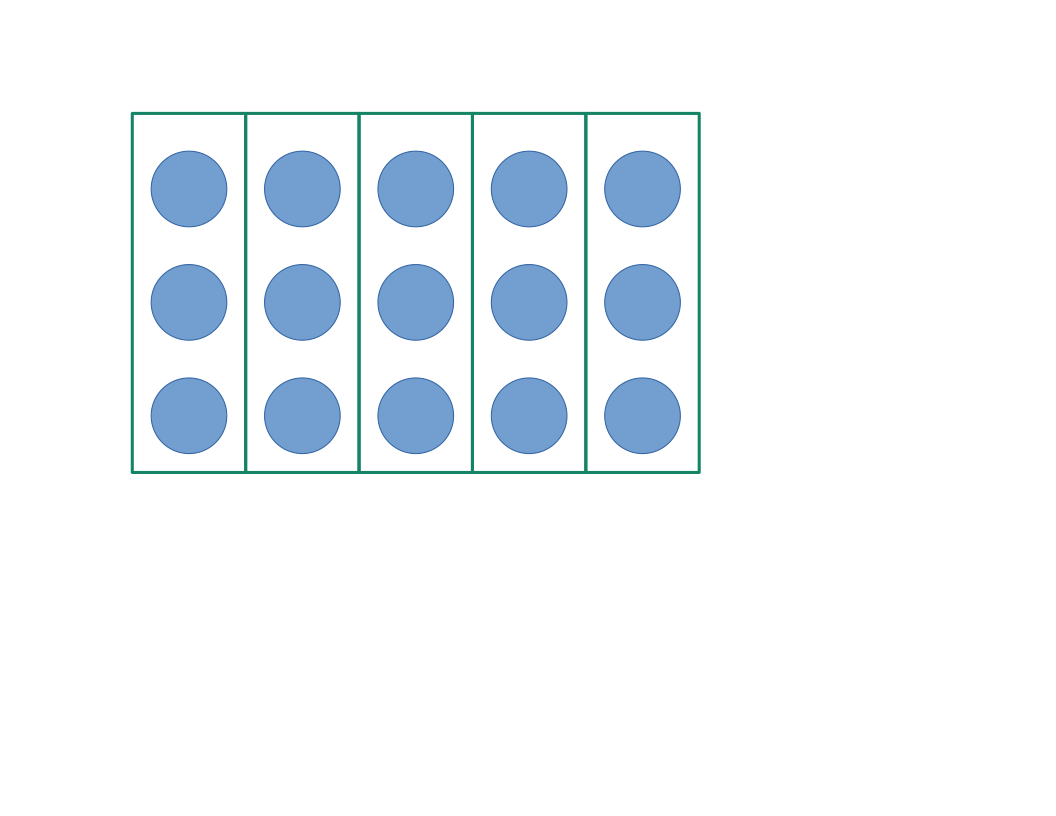
Here is a picture of the measurement model of division on both related division problems. First \(15 \div 5 = 3\text{:}\)
15 divided by 5 in dots
and now \(15 \div 3 = 5\text{:}\)
15 divided by 3 in dots
Thus we have two related division problems: \(15 \div 5 = 3\) and \(15 \div 3 = 5\text{.}\)
If we look (somewhat) carefully at the last two examples, we notice that there is nothing special about any of the numbers in the examples; the important part in the first example is splitting the top number of the subtraction into two parts, and in the second example it’s grouping our dividend horizontally and vertically (in the area model of division). We can generalize this idea to any numbers being subtracted or divided (in the case of division, with remainder of 0) using the exact logic of above. Let’s write these out as theorems below. It’s a good idea to try and prove these ourselves before looking at the proof given.
Proof.
Let’s assume the if-part of the conditional statement is true. Assume that \(a-b=c\text{.}\) Using the definition of subtraction, this means that \(a=b+c\text{.}\)
We wish to show that \(a-c=b\text{.}\) Let’s keep that in our mind so that we know where we are working to.
Since we know that \(a=b+c\text{,}\) using commutativity of addition we have that \(a=c+b\text{.}\) By the definition of subtraction, this means that \(a-c=b\text{.}\) Thus we have shown what we wanted to show.
The proof for division is very similar to the subtraction proof. If you have looked at the proof for subtraction, see if you can modify it to be a proof for the division result.
Proof.
Let’s assume the if-part of the conditional statement is true. Assume that \(a \div b=c\text{.}\) Using the definition of division, this means that \(a=b \times c\text{.}\)
We wish to show that \(a \div c=b\text{.}\) Let’s keep that in our mind so that we know where we are working to.
Since we know that \(a=b \times c\text{,}\) using commutativity of multiplication we have that \(a=c \times b\text{.}\) By the definition of division, this means that \(a \div c=b\text{.}\) Thus we have shown what we wanted to show.
Checkpoint 3.3.25.
The previous theorem had the condition that we had a remainder of \(0\text{.}\) Show that this needs to be the case; that is, find a counterexample to:
"If \(a \div b = cRr\text{,}\) where \(r \neq 0\) then \(a \div c = bRr\)".
Try a few examples with non-zero remainder. Is it true for other remainders besides zero? Compare the size of the remainder to both \(b\) and \(c\text{.}\) What needs to be true about the remainder for the above conditional statement to be true? Write down a modified conditional statement that is always true. Prove that you are correct.

Subsubsection 3.3.3.2 Multiplication By Zero

Does it have to be the case that multiplication by zero always gives and answer of zero, or is that something we just decided because it works (more specifically, do we need to make an axiom covering multiplication by zero)? In fact, it’s something that *must* follow from previous properties we’ve discussed. An important result that can be proved from axioms or previous results is called a theorem. Let’s write this as a theorem, and then prove it. We have to be careful here, since we may be tempted to simplify \(a \times 0 = 0\text{,}\) but we need to put ourselves in the mindset of the first person ever to think about this; we have no idea what it could equal, so we need to solve for it using some properties that we know.
Example 3.3.26.
Proof.
Let \(a\) be a number and let’s consider \(a \times 0\text{,}\) which is our unknown expression; this is what we need to solve for. Remember, we *cannot* simplify this. The key to this is trying to come up with a way of finding something equal to \(a \times 0\) and then using some algebra to solve for our unknown expression.
One way of doing this is remembering the multiplicative identity and additive identity properties. Let’s be very precise here, and make sure we label all of the properties we are using. By the multiplicative identity property we know
\begin{equation*} a \times 1 = a \end{equation*}
and by the additive identity property we know
\begin{equation*} 1+0 = 1 \text{.} \end{equation*}
Using substitution of equal expressions we can write
\begin{equation*} a \times (1+0) = 1 \text{.} \end{equation*}
Now using distributivity we can say that
\begin{equation*} a \times 1 + a\times 0 = a\text{.} \end{equation*}
Again, by multiplicative identity we can simplify this to
\begin{equation*} a + a\times 0 = a \text{.} \end{equation*}
Finally, by arithmetic of equal expressions we can subtract \(a\) from both sides to have \(a \times 0 = 0\text{.}\)
Keep in mind what this is saying; if we want 1 to be the multiplicative identity, 0 to be the additive identity, and the properties of equality and distributivity to hold, it *must* be the case that \(a \times 0 = 0\text{.}\) So this is a consequence of these properties; if we want to live in a mathematical world where these properties hold, then multiplying by zero *must* give you an answer of zero.

Subsubsection 3.3.3.3 Division By Zero

Why did we have the condition that our divisor \(b \neq 0\text{?}\) That is, why can’t we divide by \(0\text{?}\) Let’s see if we can show why that’s the case.
Example 3.3.28.
Let \(a \in \mathbb{N}_0\) and \(b=0\text{,}\) so \(a\) is some whole number. For now, let’s assume that there is no condition on the size of the remainder \(r\text{.}\) If \(a \div 0\) does make sense, this means there is some unique quotient \(q\) and remainder \(r\) such that \(a=q \times 0 + r\text{.}\) Thus \(a=r \text{,}\) but \(q\) can be any number and this will still hold. Since we require that quotients are unique, this does not make sense.