Subsection5.3.1Introduction to Ratios, Proportions, and Rates
Objectives:Learning Objectives
In this section, you will explore how ratios, rates, and proportions can be used to represent and solve a wide variety of mathematical and real-world problems.
Ratios, proportions, and rates are ideas that connect numbers to the real world. They help us compare quantities, scale figures up or down, and describe how two measurements change together. For example, when we say that a recipe calls for \(2\) cups of flour for every \(3\) cups of sugar, we are describing a ratio. When we say that two such comparisons are equal, we are working with a proportion. And when we describe how one quantity changes compared to another with different units—such as kilometers per hour or dollars per item—we are describing a rate.
These ideas are important in many areas of mathematics and in everyday life. Students first meet them in elementary school when comparing objects ("there are twice as many squares as circles") or when learning about fractions. In middle school, they are used in scaling drawings, converting units, understanding percentages, and working with similar figures in geometry. Later, proportional reasoning becomes a foundation for algebra, functions, and modeling real-world problems.
Ratios, proportions, and rates also help us reason more flexibly about numbers. Instead of focusing only on exact counts, they let us focus on relationships between quantities. This relational thinking is central to mathematics: whether comparing sides of a triangle, predicting outcomes in probability, or interpreting slopes of lines in algebra, proportional reasoning is the bridge that connects different ideas.
A ratio is a way of comparing two quantities. Ratios tell us how much of one thing there is compared to another. For example, we might compare the number of apples to the number of oranges in a basket, or the number of boys to the number of girls in a class. Ratios are often written in one of three ways: with a colon (e.g. \(3:4\)), with the word “to” (e.g. “3 to 4”), or as a fraction (e.g. \(\tfrac{3}{4}\)).
Given two quantities \(a\) and \(b\) (with \(b \neq 0\)), the ratio of \(a\) to \(b\) is written as \(a:b\text{,}\) and expresses how many parts of \(a\) there are for every part of \(b\text{.}\) A ratio can also be represented as the fraction \(\tfrac{a}{b}\text{.}\)
In a basket with \(6\) apples and \(4\) oranges, the ratio of apples to oranges is \(6:4\text{.}\) We can simplify this ratio, just as we do with fractions, to \(3:2\text{.}\) This means that for every 3 apples, there are 2 oranges.
If a class has 12 boys and 18 girls, the ratio of boys to girls is \(12:18\text{.}\) Simplifying gives \(2:3\text{.}\) We can interpret this as “for every 2 boys there are 3 girls.”
Ratios can also compare a part to the whole. If the same class has 12 boys and 18 girls (for a total of 30 students), then the ratio of boys to the whole class is \(12:30\text{,}\) which simplifies to \(2:5\text{.}\) This tells us that 2 out of every 5 students are boys.
Let’s look at a more involved real-world example. Suppose a drink mix calls for 2 cups of concentrate to be mixed with 5 cups of water. We want to make a large batch with 21 cups of water. How much concentrate is needed?
First, notice that the original recipe gives the ratio of concentrate to water as \(2:5\text{.}\) That means for every 5 cups of water, we need 2 cups of concentrate.
\begin{equation*}
x = \tfrac{42}{5} = 8.4
\end{equation*}
Therefore, we need 8.4 cups of concentrate. In practical terms, this means about 8 and a half cups. Notice how the ratio guided us to scale up the recipe correctly.
Just as fractions can be simplified or scaled up, ratios can also be rewritten in different but equivalent forms. If we have a ratio \(a:b\text{,}\) then for any nonzero number \(k\) we can multiply both parts of the ratio by \(k\) and obtain \((ka):(kb)\text{.}\) Since the fraction form of the ratio is \(\tfrac{a}{b}\text{,}\) and
\begin{equation*}
\tfrac{a}{b} = \tfrac{ka}{kb} \quad \text{for any } k \neq 0,
\end{equation*}
both \(a:b\) and \((ka):(kb)\) describe the same relationship between \(a\) and \(b\text{.}\) In the same way, dividing both parts of a ratio by a common factor gives a simpler equivalent ratio. This is why we often reduce ratios to their lowest terms, just as we do with fractions.
For example, the ratio \(6:4\) can be simplified by dividing both terms by 2, giving \(3:2\text{.}\) Both ratios represent the same relationship, because in each case the first quantity is one and a half times the second. The numbers may look different, but the comparison is unchanged.
Two ratios \(a:b\) and \(c:d\) are called equivalent ratios if they represent the same relationship between the two quantities. In particular, for any nonzero number \(k\text{,}\) the ratios \(a:b\) and \((ka):(kb)\) are equivalent. Equivalently, \(a:b\) and \(c:d\) are equivalent exactly when
The ratio \(8:12\) can be simplified by dividing both terms by 4, giving \(2:3\text{.}\) Since \(\tfrac{8}{12} = \tfrac{2}{3}\text{,}\) these ratios are equivalent.
Similarly, multiplying both terms of \(2:3\) by 5 gives \(10:15\text{,}\) which is also equivalent. All three ratios — \(8:12\text{,}\)\(2:3\text{,}\) and \(10:15\) — describe the same relationship.
Subsection5.3.3Part-to-Part and Part-to-Whole Comparisons
Ratios can be used in two different but related ways: to compare one part of a group to another part, or to compare one part of a group to the whole. These are called part-to-part and part-to-whole comparisons. Understanding the difference is important, since both are common in real-world situations.
The ratio of apples to the whole basket is a part-to-whole ratio: \(12:20 = 3:5\text{.}\) This tells us that 3 out of every 5 fruits in the basket are apples.
A soccer team scored 15 goals in a season: 9 by forwards, 4 by midfielders, and 2 by defenders. Compare forwards to midfielders, and forwards to the whole team.
Ratios are closely connected to fractions. A part-to-whole ratio can always be written directly as a fraction, because it compares one subset to the entire set. For example, if 12 of the 30 students in a class are boys, the ratio of boys to the whole class is \(12:30\text{,}\) which corresponds to the fraction \(\tfrac{12}{30} = \tfrac{2}{5}\text{.}\) This fraction can also be interpreted as “two-fifths of the class are boys.” A part-to-part ratio, on the other hand, can be turned into a fraction by placing one part over the other. For instance, if the same class has 12 boys and 18 girls, the part-to-part ratio is \(12:18\text{,}\) or as a fraction \(\tfrac{12}{18} = \tfrac{2}{3}\text{,}\) meaning that there are two boys for every three girls. In both cases, fractions and ratios capture the same idea of comparing quantities, but part-to-whole ratios align naturally with the notion of fractions of a whole, while part-to-part ratios highlight the relative size of two categories within the whole.
The close connection between ratios and fractions explains why proportional reasoning is such an important skill in mathematics. Part-to-whole ratios naturally lead to fractions of a whole, which in turn form the basis for understanding percentages, probabilities, and measures like slope in algebra. Part-to-part ratios can also be converted into fractions, and these comparisons are essential in statistics (for example, comparing groups within a population) and in geometry (for example, comparing the sides of similar triangles). Recognizing that ratios and fractions are two different ways of describing the same relationships helps students see mathematics as a connected whole rather than a collection of separate topics.
A proportion is a statement that two ratios are equal. Proportions are especially useful because they allow us to find missing values when two quantities change in the same way. This is one of the most common uses of ratios in problem solving: scaling up or down while keeping the same relationship.
where \(a,b,c,d\) are numbers with \(b \neq 0\) and \(d \neq 0\text{.}\) If three of the numbers are known, the fourth can be found by solving the equation. This process is sometimes called “solving a proportion.”
A school has the same student-to-teacher ratio in two grades. If one grade has 120 students and 6 teachers, how many teachers are needed for 200 students?
with \(b \neq 0\) and \(d \neq 0\text{.}\) By the property of equality, we can multiply both sides of the equation by \(bd\) without changing the truth of the statement. Doing so gives:
Subsection5.3.5Proportional Reasoning in the School Curriculum
Proportional reasoning shows up throughout the school curriculum, often in ways that may not seem connected at first. Recognizing these connections helps students see mathematics as an integrated subject rather than as separate topics. Below we highlight some important areas where proportional reasoning is central, with explicit examples.
Converting between measurement units always involves a proportion. For example, since \(1 \text{ meter} = 100 \text{ centimeters}\text{,}\) the ratio of meters to centimeters is \(1:100\text{.}\) If a board is 2.4 meters long, we can set up a proportion:
In algebra, the slope of a line is defined as the ratio of vertical change (“rise”) to horizontal change (“run”). For example, if a line passes through the points \((2,3)\) and \((6,11)\text{,}\) then the slope is
This tells us that for every 1 unit we move to the right, the line rises 2 units. Slope is therefore a constant ratio that describes the proportional relationship between changes in \(x\) and \(y\text{.}\)
If two shapes are similar, their corresponding side lengths are proportional. For instance, suppose a small triangle has side lengths 3 cm, 4 cm, and 5 cm. A larger similar triangle has its shortest side equal to 9 cm. Since the scale factor is \(9 \div 3 = 3\text{,}\) the other sides must be \(4 \times 3 = 12\) cm and \(5 \times 3 = 15\) cm.
Ratios are also at the heart of probability. If a bag contains 8 red marbles and 12 blue marbles, then the probability of drawing a red marble at random is the part-to-whole ratio
These examples show that proportional reasoning connects many topics that students study across grade levels. Whether converting units, interpreting percentages, graphing lines, working with similar figures, or calculating probabilities, the underlying structure is the same: one quantity changes in a constant ratio with another.
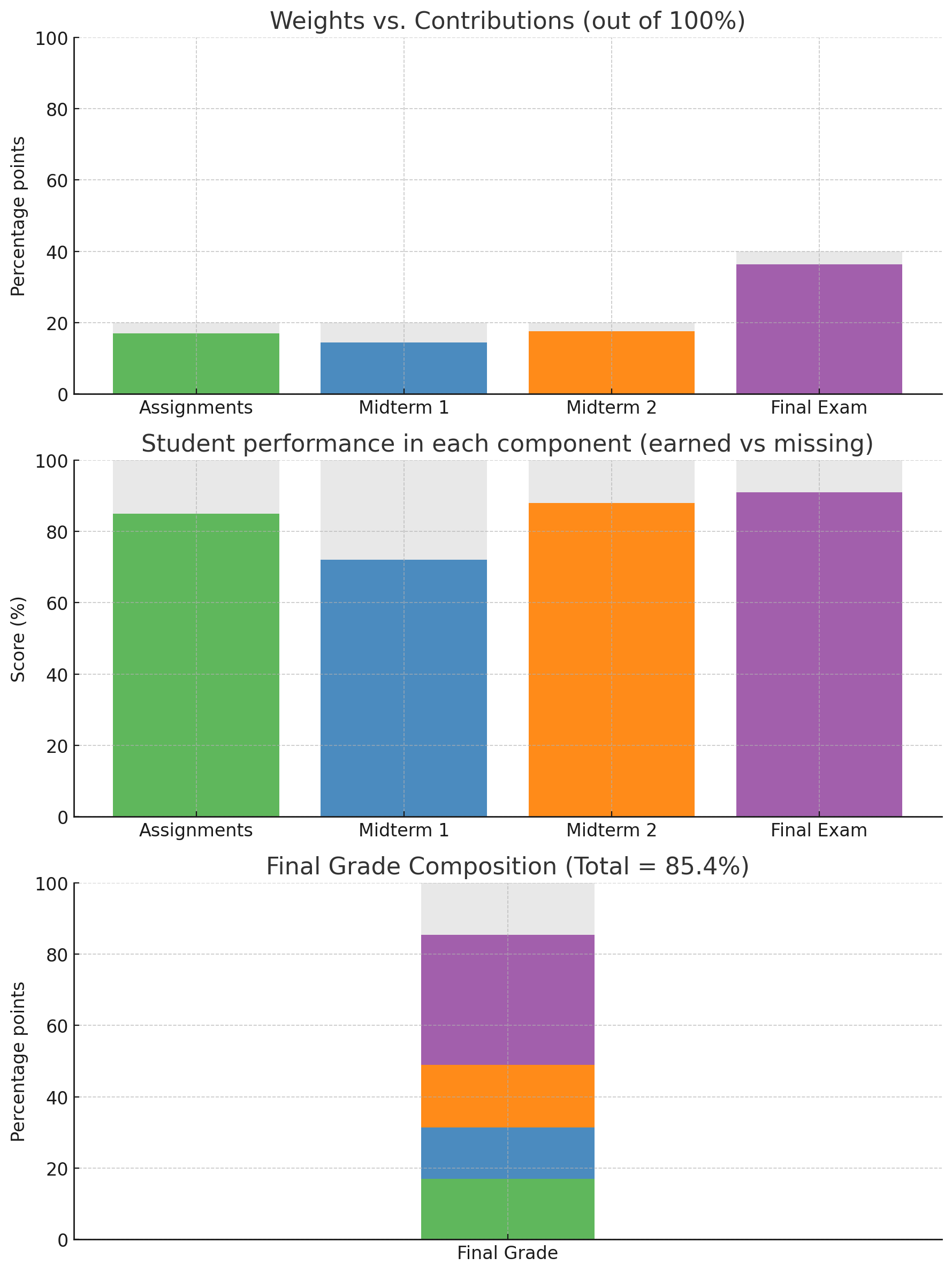
Final Grade via Proportional Reasoning: A student’s grade in a course is based on four components: assignments worth 20%, midterm 1 worth 20%, midterm 2 worth 20%, and a final exam worth 40%. Suppose the student earns 85% on assignments, 72% on midterm 1, 88% on midterm 2, and 91% on the final exam. What is the overall grade?
Each component contributes to the final grade in proportion to its weight. For example, assignments are worth 20% of the course, which is a part-to-whole ratio of \(20:100\text{.}\) Within this 20% of the course, the student has earned 85% of the possible points. So the proportion
compares the contribution \(C_{\text{A}}\) (in course percentage points) to the weight 20, just as the score compares to 100. Solving the proportion gives
Therefore the student’s overall grade is 85.4%. Each step used a proportion: the student’s score out of 100 compared to their contribution out of the component’s weight. Summing these proportional parts gives the whole course grade. Here is a picture showing this.