Section 5.1 Introduction to Fractions

In this chapter, we will explore the concept of fractions and rational numbers, which are vital in understanding many mathematical concepts and applications. As future elementary school teachers, it is essential to have a firm grasp of fractions to effectively teach students and build a strong foundation in mathematics.
Fractions represent a way to express parts of a whole. They have two components: the numerator, which indicates the number of equal parts considered, and the denominator, which represents the total number of equal parts that make up the whole. Of course, it’s easy to see that we can divide one whole into 2 halves, or 3 thirds, or in general \(n\) \(n\)ths for any \(n \in \mathbb{N}.\)

Definition 5.1.1.

A fraction is an ordered pair of integers \((a, b)\text{,}\) where \(a\) is the numerator and \(b\) is the denominator, such that \(b \neq 0\text{.}\) We write a fraction as \(\dfrac{a}{b}\text{.}\)
Fractions can also be related to solutions of linear equations with integer coefficients. We will now define fractions in terms of solutions to linear equations.

Definition 5.1.2.

Let \(a, b \in \mathbb{Z}\text{,}\) where \(\mathbb{Z}\) represents the set of integers, and \(b \neq 0\text{.}\) A fraction \(\dfrac{a}{b}\) is a solution to the linear equation \(bx = a\text{.}\)
The definition above allows us to build the idea of fractions from ideas that we’ve developed before, namely arithmetic of integers.

Subsection 5.1.1 Examples of Fractions

Example 5.1.3.

Consider the fraction \(\dfrac{1}{2}\text{.}\) This represents one part of a whole that is divided into two equal parts.
Figure 5.1.4.

Example 5.1.5.

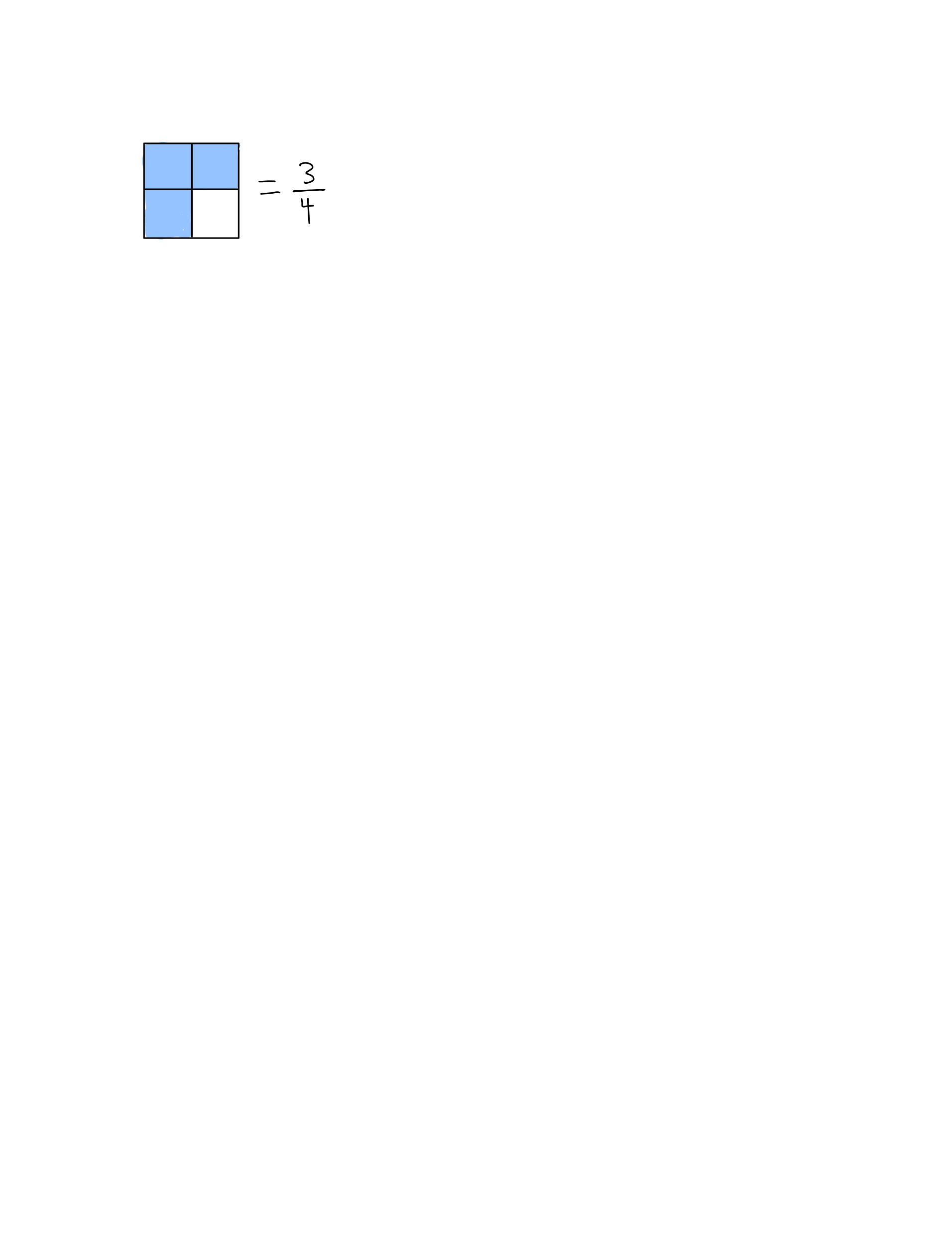
Now, consider the fraction \(\dfrac{3}{4}\text{.}\) This represents three parts of a whole that is divided into four equal parts.

Subsection 5.1.2 Making Sense Of Fractions and Division of Whole Numbers

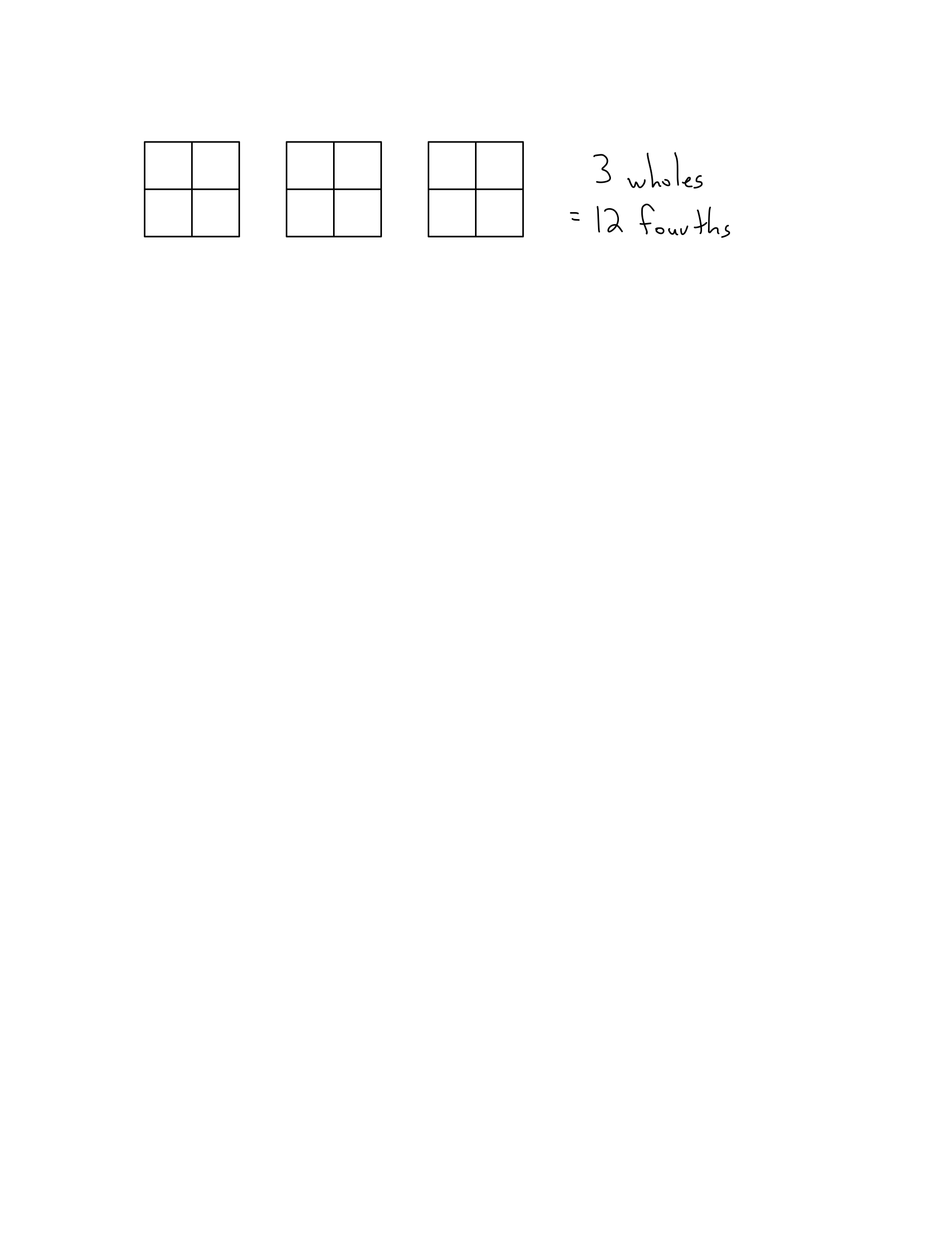
For whole numbers \(a,b\) with \(b \neq 0\) we can think of the fraction problem \(a \div b\) as dividing \(a\) into \(b\) equal groups. The number of pieces in each group is indeed \(\dfrac{a}{b}\text{.}\) For example, if we wanted to divide \(3\) into \(4\) we could first divide each whole into fourths, giving us 4 fourths for each whole, so \(3 \times 4 = 12\) fourths.
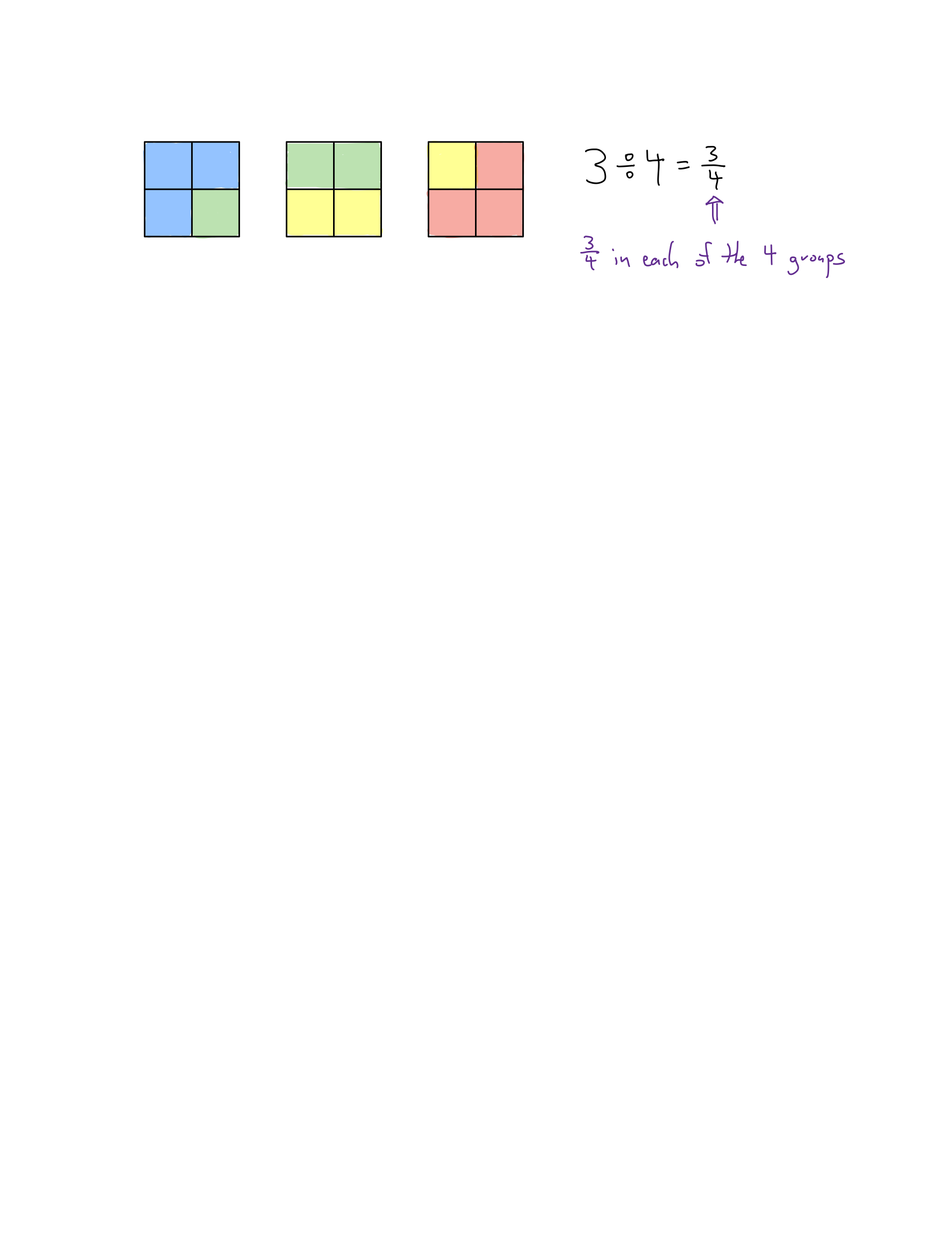
Now we want to divide 12 objects, these objects being fourths of a whole, into 4 groups. By division of whole numbers we know that there must be \(12 \div 4 = 3\) fourths in each group.
So in total, there are 3 fourths in each group, which we can represent by the fraction \(\dfrac{3}{4}.\)

Subsection 5.1.3 Equivalent Fractions

In this subsection, we will discuss the concept of equivalent fractions. Equivalent fractions represent the same part of a whole, even though their numerators and denominators may be different.

Definition 5.1.6.

Two fractions \(\dfrac{a}{b}\) and \(\dfrac{c}{d}\) are called equivalent fractions if \(ad = bc\text{.}\) In other words, they represent the same quantity or part of a whole. In fact, you can see that we can take a fractional representation and either "chop" each piece into \(n\) equal sized pieces, which corresponds to multiplying both the numerator and denominator by \(n\text{,}\) or "gluing" \(n\) equal pieces together to make a larger equal piece, which corresponds to dividing the numerator and denominator by \(n\text{.}\) Note that in the second case, you need to be able to make equal groups of size \(n\text{,}\) so this means that both the numerator and denominator must be divisible by \(n\text{.}\)

Example 5.1.7.

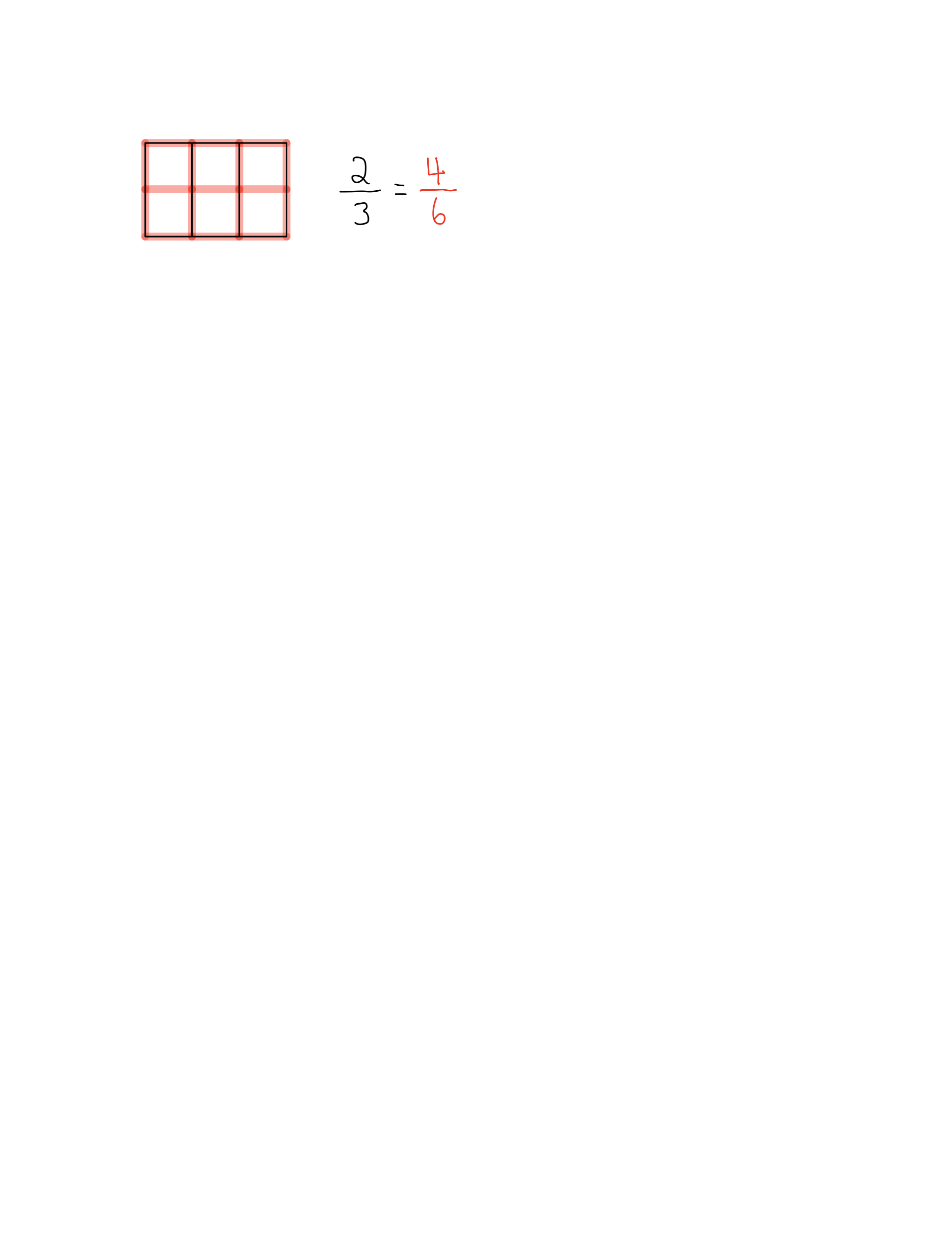
Consider the fractions \(\dfrac{2}{3}\) and \(\dfrac{4}{6}\text{.}\) These fractions are equivalent because \(2 \times 6 = 3 \times 4\text{.}\) Equivalently, since we can multiply each of \(2\) and \(3\) by \(2\) to get \(4\) and \(6\) (or divide \(4\) and \(6\) by \(2\text{,}\) conversely), you can see that these are equivalent fractions.

Example 5.1.8.

Consider the fractions \(\dfrac{3}{5}\) and \(\dfrac{6}{10}\text{.}\) These fractions are equivalent because \(3 \times 10 = 5 \times 6\text{.}\)

Subsection 5.1.4 Comparing Fractions Using a Common Denominator

In this subsection, we will learn how to compare two fractions using a common denominator. The idea of using a common denominator is essential for comparing fractions as it allows us to compare the relative sizes of the numerators. We will start with an example where the fractions have the same denominator and then introduce the concept of equivalent fractions to compare fractions with different denominators.

Example 5.1.9. Comparing Fractions with the Same Denominator.

Let’s say we want to compare the fractions \(\dfrac{3}{5}\) and \(\dfrac{2}{5}\text{.}\) Since both fractions have the same denominator of 5 (remember that "fifths" denote the units of which we have 2 and 3 of, respectively), we can simply compare the numerators. In this case, 3 is greater than 2, so \(\dfrac{3}{5} > \dfrac{2}{5}\text{.}\)
Now let’s move on to comparing fractions with different denominators. To do this, we will use the concept of equivalent fractions.

Definition 5.1.10. Equivalent Fractions.

As a reminder, two fractions are considered equivalent if they represent the same value. This can be determined by cross-multiplying the fractions and checking if the resulting products are equal. In other words, two fractions \(\dfrac{a}{b}\) and \(\dfrac{c}{d}\) are equivalent if \(ad = bc\text{.}\)
To compare two fractions with different denominators, we can find equivalent fractions that have the same denominator. The way to do this so that the denominators are as small as possible is by finding least common denominator (LCD), which is the smallest multiple of both denominators.
More precisely, if \(b\) and \(d\) are two denominators, then the least common denominator is smallest number \(f\) such that \(f=xb=yd\) for some \(x,y \in \mathbb{N}\text{.}\) Thus, if we wanted \(\dfrac{a}{b}\) and \(\dfrac{c}{d}\) to have a common denominator, we multiply the top and bottom of the first fraction by \(x\) and the second fraction by \(y\) to get \(\dfrac{ax}{bx}=\dfrac{ax}{f}\) and \(\dfrac{cy}{dy}=\dfrac{cy}{f}\text{.}\) Now both quantities are fractions that have the same denominator.
For example, fractions equivalent to \(\dfrac{5}{6} \) and \(\dfrac{3}{10} \) would be \(\dfrac{25}{30}\) and \(\dfrac{9}{30}\) since \(30\) is the smallest multiple of both \(6\\) and \(10 \text{.}\) We multiply the numerator and denominator of \(\dfrac{5}{6} \) by \(5\) since \(30=6 \times 5\) and we multiply the numerator and denominator of \(\dfrac{3}{10} \) by \(3\) since \(30=3 \times 10\text{.}\)
INSERT PIC HERE
Another way to do this, but which might end up with fractions with larger integers making up the numerators and denominators, is to multiply the numerator and denominator of a fraction by the denominator of the other, and vice versa. Thus, if we wanted \(\dfrac{a}{b}\) and \(\dfrac{c}{d}\) to have a common denominator, we multiply the top and bottom of the first fraction by \(d\) and the second fraction by \(b\) to get \(\dfrac{ad}{bd}\) and \(\dfrac{bc}{bd}\text{.}\) Now both quantities are fractions that have the same denominator.
Once we have the equivalent fractions, we can compare them as we did in the first example. Note that using this method, the fractions might not have the least common denominator.
For example, if we want fractions equivalent to \(\dfrac{1}{4} \) and \(\dfrac{3}{10} \) we can multiply the numerator and denominator of the first fraction by \(10\) and the second by \(4\) to obtain \(\dfrac{10}{40} \) and \(\dfrac{12}{40}. \) We can think of this using an area model for fractions as well:
INSERT PIC HERE

Example 5.1.11. Comparing Fractions with Different Denominators.

Let’s compare the fractions \(\dfrac{3}{4}\) and \(\dfrac{5}{6}\text{.}\) Using the first method above, we need to find the LCD, which is the smallest multiple that both denominators (4 and 6) can divide into. In this case, the LCD is 12. So, using the notation above, \(x=3\) and \(y=2\) since \(12=3\times 4 = 2 \times 6.\)
Now, we need to find equivalent fractions for \(\dfrac{3}{4}\) and \(\dfrac{5}{6}\) with a denominator of 12. We can do this by multiplying the numerator and denominator of each fraction by the same number, such that the denominator becomes 12:
\begin{equation*} \dfrac{3 \times 3}{3 \times 4} = \dfrac{9}{12}, \quad \dfrac{2 \times 5}{2 \times 6} \cdot \dfrac{2}{2} = \dfrac{10}{12} \end{equation*}
So, \(\dfrac{3}{4}\) is equivalent to \(\dfrac{9}{12}\) and \(\dfrac{5}{6}\) is equivalent to \(\dfrac{10}{12}\text{.}\) Now, we can compare the numerators of these equivalent fractions: 9 is less than 10, so \(\dfrac{3}{4} < \dfrac{5}{6}\text{.}\)
Alternatively, we could have used the second method and compared the fractions \(\dfrac{18}{24}\) and \(\dfrac{20}{24}\) and ended up with the same result.

Subsection 5.1.5 Comparing Multiple Fractions

Now that we have covered comparing two fractions, let’s consider an example where we compare three fractions of increasing difficulty. The method remains the same: we will find equivalent fractions with a common denominator and then compare their numerators.

Example 5.1.12. Comparing Three Fractions.

Let’s compare the following fractions: \(\dfrac{2}{3}\text{,}\) \(\dfrac{5}{9}\text{,}\) and \(\dfrac{7}{12}\text{.}\) First, we need to find the least common denominator (LCD), which is the smallest multiple that all three denominators (3, 9, and 12) can divide into. In this case, the LCD is 36. So, we have \(x=12\text{,}\) \(y=4\text{,}\) and \(z=3\) since \(36 = 12 \times 3 = 4 \times 9 = 3 \times 12\text{.}\)
Now, we need to find equivalent fractions for each fraction with a denominator of 36:
\begin{equation*} \dfrac{2 \times 12}{3 \times 12} = \dfrac{24}{36}, \quad \dfrac{5 \times 4}{9 \times 4} = \dfrac{20}{36}, \quad \dfrac{7 \times 3}{12 \times 3} = \dfrac{21}{36} \end{equation*}
So, \(\dfrac{2}{3}\) is equivalent to \(\dfrac{24}{36}\text{,}\) the fraction \(\dfrac{5}{9}\) is equivalent to \(\dfrac{20}{36}\text{,}\) and \(\dfrac{7}{12}\) is equivalent to \(\dfrac{21}{36}\text{.}\) Comparing the numerators of these equivalent fractions, we have \(20 < 21 < 24\text{.}\) Thus, the order of the fractions from smallest to largest is: \(\dfrac{5}{9} < \dfrac{7}{12} < \dfrac{2}{3}\text{.}\)
Note that since we can always compare the sizes of two fractions we can place these on a number line, just like we did for whole numbers.
ADD PIC HERE

Subsection 5.1.6 Density of Fractions

In this subsection, we will discuss the density of fractions, why it is important to understand this concept, and provide a first-year math level definition of density. We will also walk through three examples of finding a fraction between two given fractions, using the idea of equivalent fractions and estimating a fraction between them, with increasing order of difficulty.

Definition 5.1.13. Density of Fractions.

The set of fractions is said to be dense if, for any two distinct fractions, there always exists another fraction between them. In other words, no matter how close two fractions are, we can always find another fraction that lies between them.
Understanding the density of fractions is important because it provides insights into the structure of the set of fractions and helps us appreciate the infinite number of fractions that exist between any two given fractions. This concept also plays a crucial role in understanding the properties of real numbers, as the set of fractions (rational numbers) is a subset of the real numbers.

Example 5.1.14. Example 1: Finding a Fraction Between Two Fractions.

Let’s find a fraction between \(\dfrac{1}{4}\) and \(\dfrac{2}{3}\text{.}\) One way to do this is by finding equivalent fractions with a common denominator. The least common denominator (LCD) of 4 and 3 is 12, so the equivalent fractions are:
\begin{equation*} \dfrac{1}{4} = \dfrac{3}{12}, \quad \dfrac{2}{3} = \dfrac{8}{12} \end{equation*}
Now, we can simply choose a fraction with the same denominator that lies between the two equivalent fractions. In this case, \(\dfrac{5}{12}\) is a fraction between \(\dfrac{1}{4}\) and \(\dfrac{2}{3}\text{.}\)

Example 5.1.15. Example 2: Finding a Fraction Between Two Fractions.

Now let’s find a fraction between \(\dfrac{2}{5}\) and \(\dfrac{3}{4}\text{.}\) We can start by finding equivalent fractions with a common denominator. The LCD of 5 and 4 is 20, so the equivalent fractions are:
\begin{equation*} \dfrac{2}{5} = \dfrac{8}{20}, \quad \dfrac{3}{4} = \dfrac{15}{20} \end{equation*}
We can now choose a fraction with the same denominator that lies between the two equivalent fractions. In this case, \(\dfrac{11}{20}\) is a fraction between \(\dfrac{2}{5}\) and \(\dfrac{3}{4}\text{.}\)

Example 5.1.16. Example 3: Finding a Fraction Between Two Fractions.

Finally, let’s find a fraction between \(\dfrac{5}{7}\) and \(\dfrac{8}{11}\text{.}\) We begin by finding equivalent fractions with a larger common denominator. The LCD of 7 and 11 is 77, so the equivalent fractions are:
\begin{equation*} \dfrac{5}{7} = \dfrac{55}{77}, \quad \dfrac{8}{11} = \dfrac{56}{77} \end{equation*}
In this case, the two equivalent fractions are already adjacent, so we need to find a larger common denominator to obtain a fraction between them. Let’s try using a common denominator of 154, which is twice the previous LCD. Thus we multiply the numerators and denominators of both fractions by 2:
\begin{equation*} \dfrac{55}{77} = \dfrac{110}{154}, \quad \dfrac{56}{77} = \dfrac{112}{154} \end{equation*}
Now, we can choose a fraction with the same denominator that lies between the two equivalent fractions. In this case, \(\dfrac{111}{154}\) is a fraction between \(\dfrac{5}{7}\) and \(\dfrac{8}{11}\text{.}\)
In the previous example, this is in some sense the "worst case scenario" where our numerators differ by 1. However, we could overcome this difficulty by breaking each unit in two. This idea will work for every two fractions where we want to find another between them. Let’s prove this precisely. First we need a small "lemma", which is the name for a mathematical result used in another larger mathematical result.

Proof.

Since \(a\) is even we know that \(a=2k\) for some whole number \(k\text{.}\) We also know the next largest even number is \(2(k+1)=2k+2=a+2 \text{.}\) Since \(b\) is an even integer and \(a < b\) then \(a+2 \leq b \text{.}\) Clearly \(a+1 < a+2 \) and thus putting it all together, \(a < a+1 < b.\)
If two fractions have the same denominator, we can easily compare numerators to determine which is bigger. Further, if we know both numerators are even, we can use the lemma above to find a fraction in between both. Luckily, we can use the idea of equivalent fractions to let us do this. In fact, we did this in the previous example. Let’s now show we can do this for every two fractions.

Proof.

First, we find equivalent fractions for \(\dfrac{a}{b}\) and \(\dfrac{c}{d}\) with a common denominator \(2bd\text{:}\)
\begin{equation*} \dfrac{a}{b} \cdot \dfrac{2d}{2d} = \dfrac{2ad}{2bd}, \quad \dfrac{c}{d} \cdot \dfrac{2b}{2b} = \dfrac{2bc}{2bd} \end{equation*}
Now, we have \(\dfrac{2ad}{2bd} < \dfrac{2bc}{2bd}\text{,}\) and since we have a common denominator this means that \(2ad < 2bc\text{.}\) Since both \(2ad\) and \(2bc\) are even integers, we can apply the lemma above. Therefore, there exists an odd integer \(2ad + 1\) such that \(2ad < 2ad + 1 < 2bc\text{.}\)
This means that \(\dfrac{2ad}{2bd} < \dfrac{2ad + 1}{2bd} < \dfrac{2bc}{2bd}\text{,}\) which is equivalent to \(\dfrac{a}{b} < \dfrac{2ad + 1}{2bd} < \dfrac{c}{d}\text{.}\)
The theorem above demonstrates the density of fractions because it shows that given any two distinct fractions \(\dfrac{a}{b}\) and \(\dfrac{c}{d}\text{,}\) we can always find another fraction \(\dfrac{2ad + 1}{2bd}\) that lies between them. This property holds true for any choice of \(a, b, c,\) and \(d\text{,}\) as long as \(b, d > 0\text{.}\) Consequently, no matter how close together two fractions might be, there will always be another fraction in between them, illustrating that the set of fractions is dense.