Section 2.1 Equality

Subsection 2.1.1 Intro To Equality

In our mathematical career we have used the equals symbol "=" countless times. In this section, we talk about what it actually means and its implications. We’ll focus on equality of numbers, but know that equality is a concept that is used in many different concepts in mathematics; for example, two sets can be equal, or two polygons can be equal.

Definition 2.1.1.

We say that two numbers \(a\) and \(b\) are equal, and write \(a=b\text{,}\) if and only if they are the same quantity. Note that they may be expressed in different ways.

Example 2.1.2.

Here are a few examples stating what we mean.
  1. \(2+3=1+4\text{.}\) This means that these two expressions are the same number (in this case \(5\)) written in different ways.
  2. Another important and common example is equality of fractions. We will explore this more later in the book, but we know that \(\frac{1}{2} = \frac{2}{4}\text{.}\)
  3. If we write \(x=7\text{,}\) this means that whenever we see the quantity \(x\) again in our problem, we can say that it is the same as the number \(7\text{.}\) Thus we can "substitute" \(7\) for \(x\) whenever we like.
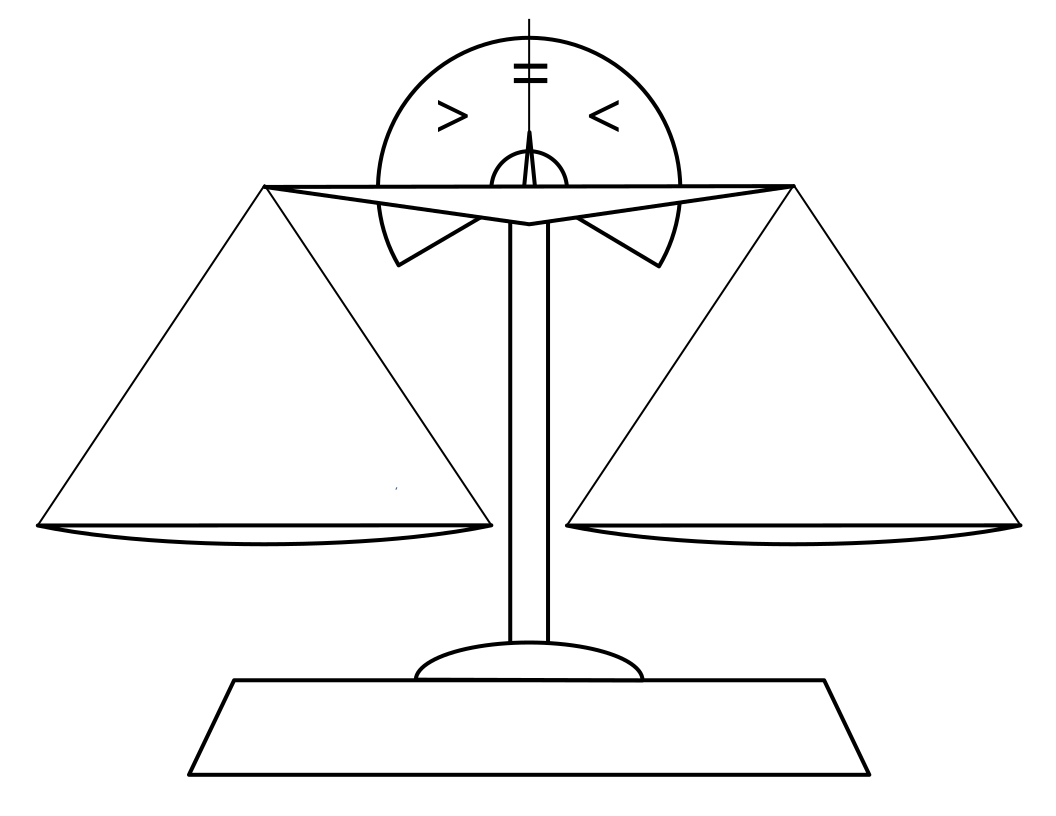
A good idea is to think of equality as a balance. If both sides are equal, then the balance will be balanced; neither side will be heavier than the other.
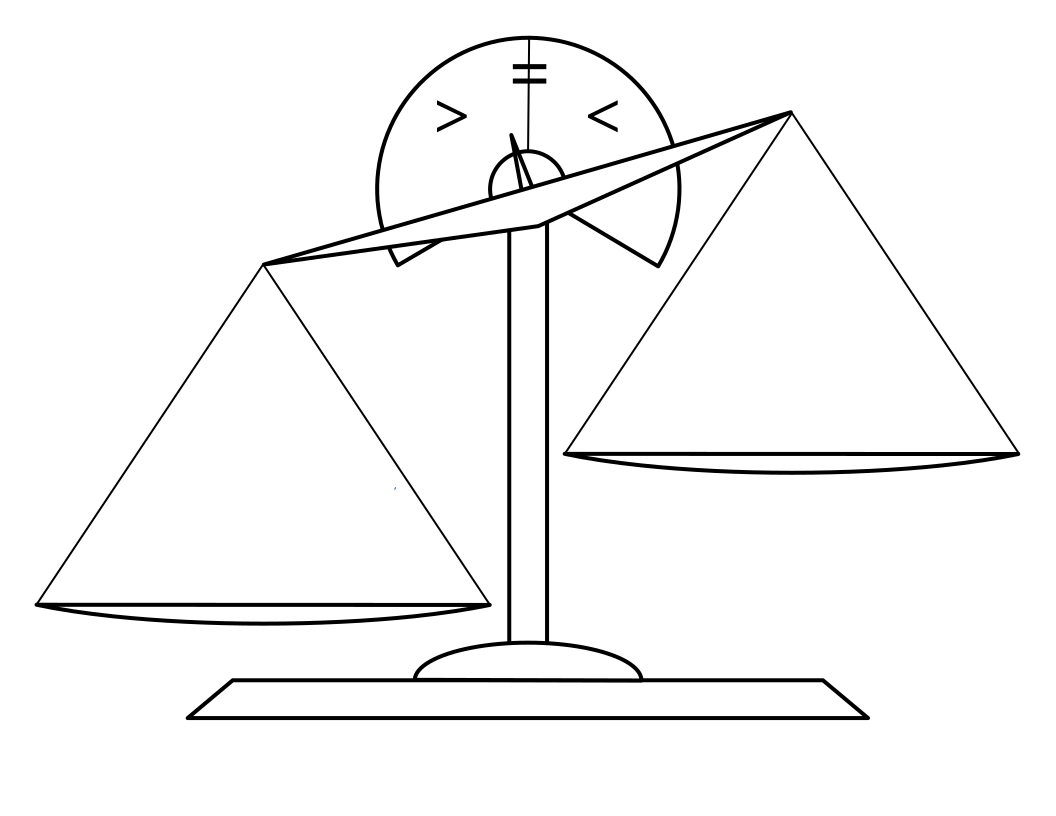
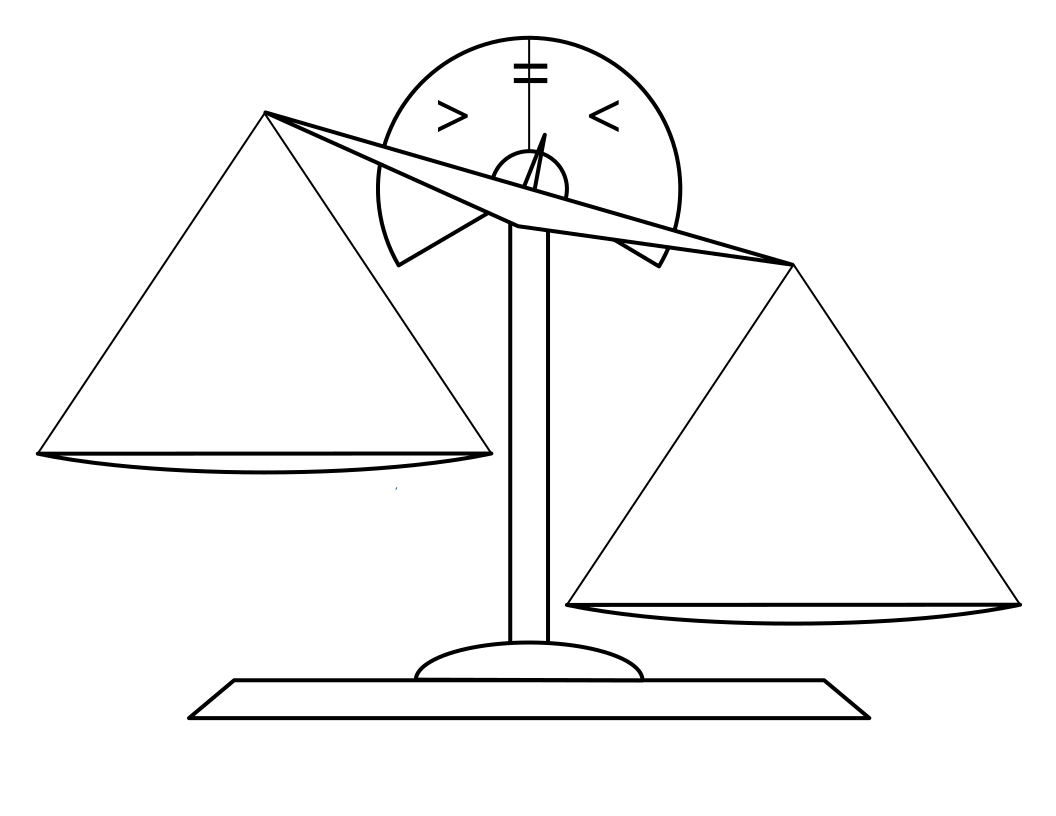
If one side of the equation is larger than the other, then we have an inequality since the two sides do not equal each other. If the left hand side (LHS) is the heavier side then we say that the LHS is greater than the right hand side (RHS). If the RHS is larger, than we say that the LHS is less than the RHS. Note that the symbol to denote either greater than \(>\) and less than \(<\) has the more open side toward the larger quantity, somewhat matching up with the idea of the balance.
Using the balance analogy greater than looks like:
Greater than balance model
and less than looks like:
Less than balance model

Subsection 2.1.1.1 Properties Of Equality

There are a few properties of equality that are important and intuitive, but for completeness we write them down here:
Properties of Equality.
  1. Reflexivity: for all numbers \(a\text{,}\) \(a = a\)
  2. Symmetry: if \(a = b\) then \(b = a\)
  3. Transitivity: if \(a = b\) and \(b=c\) then \(a = c\)
Notes for Additional Understanding.
Note that the three properties above are used to define another, more general, concept in mathematics called an equivalence relation. Informally, this is a type of relation, but it calls objects equivalent if they behave the same way in only ways that you are interested in working with. For more information, see any discrete mathematics textbook.
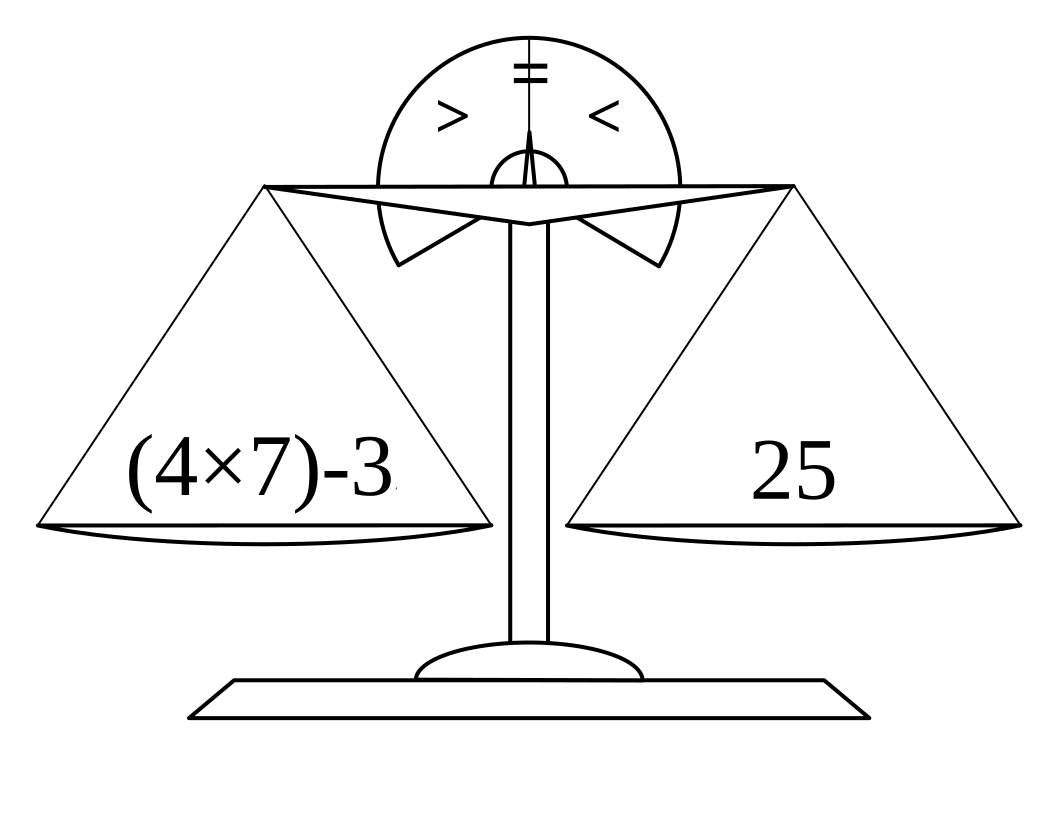
The most important property of equality when doing mathematics is that you can always substitute one expression for another equal to it. In fact, this is how many algebraic equations are solved, and arithmetic expressions simplified. We regularly do this whenever we simplify an arithmetic expression, but many of us do not realize we are doing a substitution when we do it! For example, if we are calculating the expression \(4 \times 7 - 3\text{,}\) we know that \(4 \times 7 = 28\text{.}\) Since these two quantities equal each other, we can substitute \(28\) any time we see the expression \(4 \times 7\text{.}\) Doing this, we get \(28-3\text{,}\) and we know that \(28-3=25.\) So, putting it all together we have that \(4 \times 7 -3 = 25\text{.}\) We can view this idea using the balance model described above:
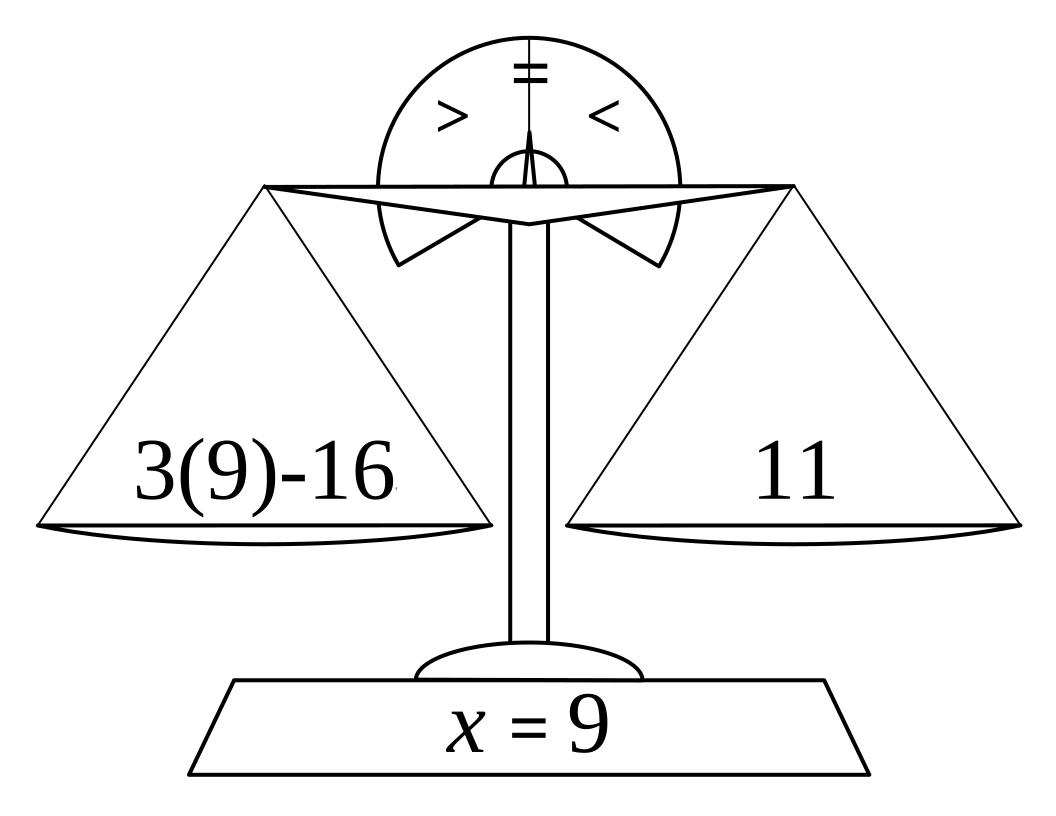
We use this idea when solving equations as well. Suppose we know that \(x=9\) and we’re asked to calculate \(3x-16\text{.}\) Since \(x\) and \(9\) are indeed equal we can substitute a \(9\) where ever we see the variable \(x\text{.}\) Doing so we obtain \(3(9)-16\text{.}\) Similarly to above we can simplify this to \(27-16=11\text{.}\) And thus \(3x-16=11\) when \(x=9\text{.}\) Again, we can use a balance model to show this process:
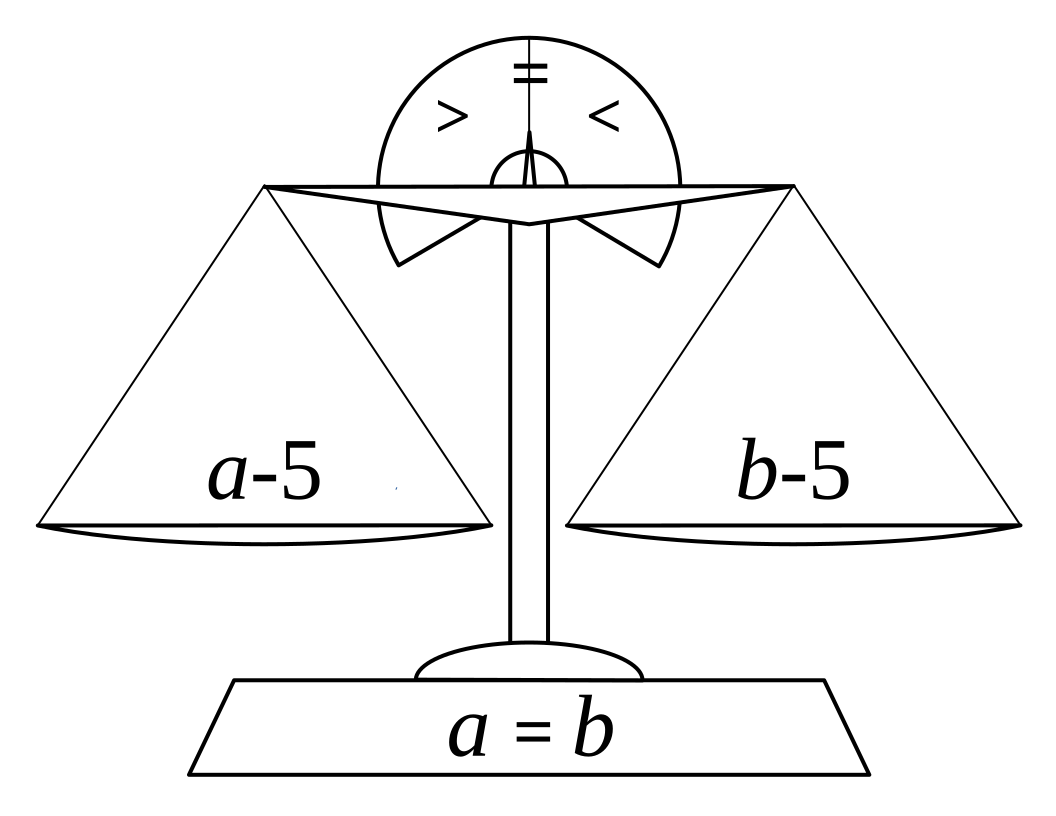
Another important property to equality is that two expressions remain equal when we do the same arithmetic operations to them. For example, if we know \(a=b\) we can subtract 5 from both of these and the resulting expressions equal: \(a-5=b-5\text{.}\)
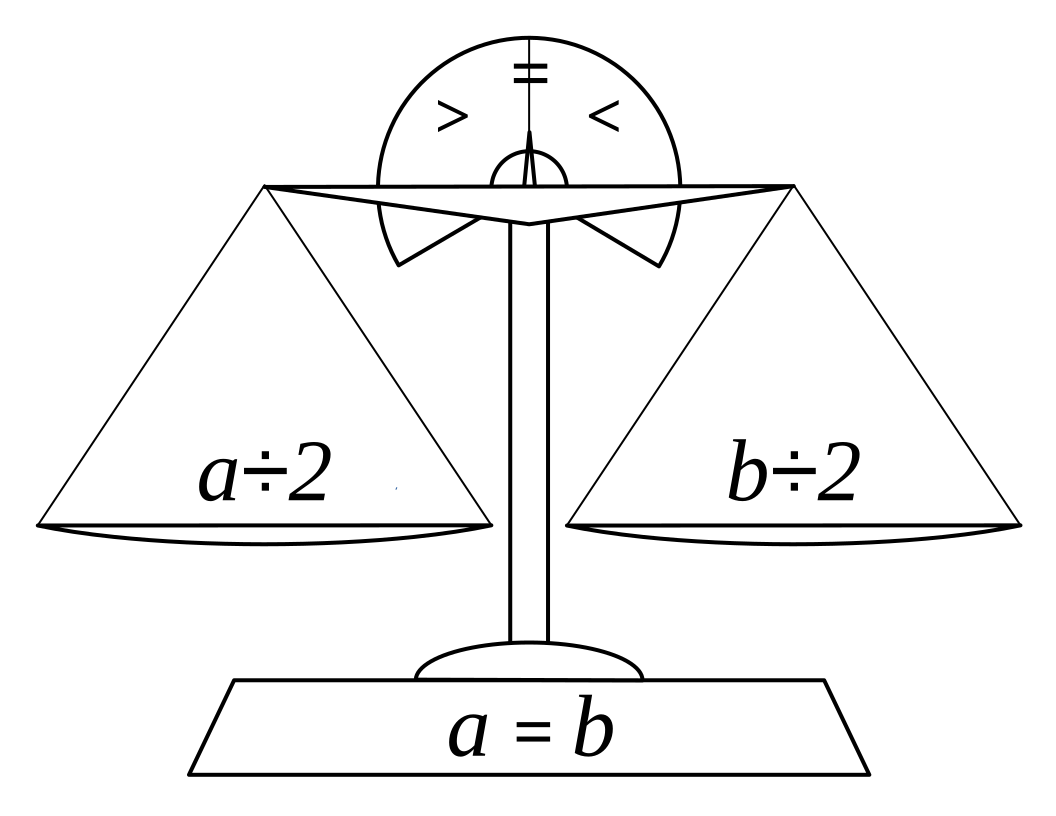
Or for another example, we could divide both sides by 2, and then \(a \div 2 = b \div 2\text{.}\)
This is an incredibly powerful idea that allows us to solve equations for unknown quantities.
Let’s define these more precisely so we can refer to them later.

Definition 2.1.3.

  1. Let \(s\) and \(t\) be expressions with \(s=t\text{.}\) For any expression \(F(x)\) with a single placeholder “\(x\)”, write \(F(s)\) for the result of uniformly replacing every free occurrence of the placeholder by \(s\text{,}\) and similarly for \(F(t)\text{.}\) Then
    \begin{equation*} s=t \implies F(s)=F(t). \end{equation*}
    For example, if \(2+3=5\text{,}\) then \((2+3)^2+5=5^2+5\) where \(F(x)=x^2+5\text{.}\)
  2. If \(L=R\) is an equation, and \(c\) is any number (or variable that represents a number) then
    1. \(\displaystyle L+c = R+c\)
    2. \(\displaystyle L-c = R-c\)
    3. \(\displaystyle L \times c = R \times c\)
    4. \(L \div c = R \div c\) as long as \(c \neq 0.\)
    We call this the property of arithmetic equality.
The next example will talk about how the above properties of equality allow us to solve equations using two methods.

Example 2.1.4.

Suppose we know that Angela is thirty years younger than her father. Also, that in ten years, Angela will be half the age of her father at that time. Let’s determine Angela’s current age, and her father’s current age.
First, we ask "what quantities are we interested in, but are unknown?". In this example, we are interested in Angela’s current age and her father’s current age. To help us write these algebraically, let’s give these quantities variable names (and we need to be specific about what these variables stand for, so that readers, and ourselves, do not get confused.)
Let \(A := \) Angela’s current age (in years), and let \(F := \) Angela’s father’s current age (in years).
Since Angela is thirty years younger than her father, we need to think about how to translate this to an algebraic statement. We can think of trying to reword this sentence to have the concept of equality in it. For example, we could say "Angela’s age plus thirty years is the same age as her father" or "If you subtract thirty years from her father’s age, it will be Angela’s age" or something else. Using the first rewording, we can make the algebraic equation
\begin{equation*} A+30 = F. \end{equation*}
For the second sentence, we need to be careful; remember that this holds in ten years time. So Angela’s age in ten years is \(A+10\) and her father’s is \(F+10\text{.}\) Now we know that in ten years, Angela will be half the age of her father, which means if you double her age then, it will be equal to her father’s age. So we can write
\begin{equation*} 2 \times (A+10) = F+10. \end{equation*}
Now, in our problem both equations are things that are true, so we can use both at the same time. Here we can use substitution to replace the \(F\) in the second equation with \(A+30\) since these quantities equal in the first equation. This way, we will end up with an equation with only one unknown/variable, which we can solve using the properties of arithmetic of equal expressions.
\begin{equation*} 2 \times (A+10) = (A+30) \end{equation*}
Expanding the bracket on the left hand side:
\begin{equation*} 2A+20 = A+30 \end{equation*}
Subtracting \(A\) and \(20\) from both sides (this will have our variable only on one side and our constants only on the other)
\begin{equation*} A = 10 \end{equation*}
So we know that Angela’s current age is \(10\) years old. We can then use the first equation to find her father’s current age using substitution again:
\begin{equation*} (10) + 30 = F \end{equation*}
\begin{equation*} 40 = F \end{equation*}
and thus Angela’s father’s current age is \(40\) years old.