Section 3.2 Arithmetic Operations

In this section, we will talk about the four main operations of arithmetic of whole numbers; addition, subtraction, multiplication, and division. The idea is that we will start with the idea of addition, and "build" the others from that. Indeed, mathematicians like to start with as little as possible, and making as many results and ideas out of this starting place as we can.
Once we talk about these operations, we can then talk about some nice properties that (some of) these operations have, which allows us to rearrange and regroup numbers so we can easily perform operations. Then, we’ll talk about common (and uncommon!) rules, called algorithms, that we use to do arithmetic. We’ll learn the steps in the algorithms, and why these algorithms work!
A reminder; we use the notation \(\mathbb{N}_0\) to mean the set of whole numbers \(\{0, 1, 2, 3, \ldots \}\text{.}\)

Subsection 3.2.1 Addition

Addition is an operation that we usually have an intuitive grasp of. There are two common ways of viewing addition (called addition models); the "set model," where we combine two sets (with no elements in common; that is, an empty intersection) into one set, and the "number line model", where we start at one number on the number line, and add additional spaces according to the number we’re adding to the first one.
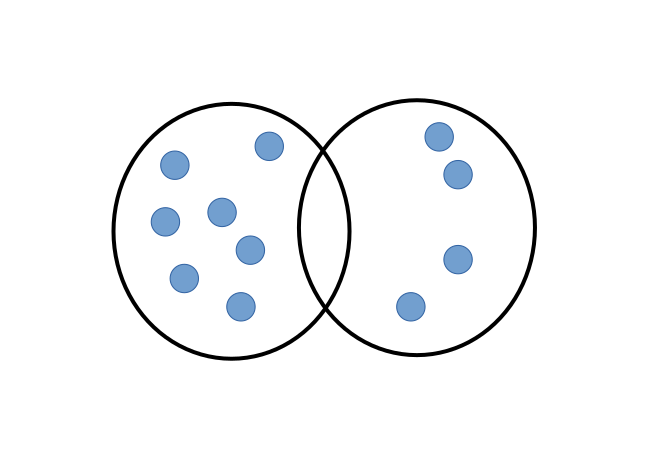
Here is the set model:
Set Model for 7+4
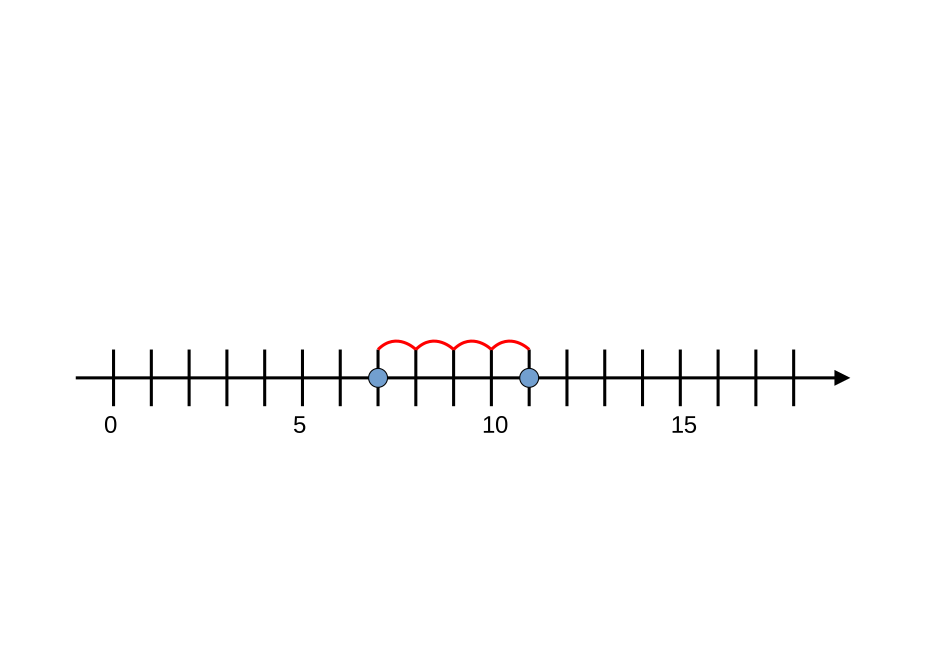
Here is the number line model:
Number Line Model for 7+4
As addition is quite intuitive, we’ll take the ability to add numbers as a given (in math we call this an axiom).

Definition 3.2.1.

Let \(a,b \in \mathbb{N}_0\text{.}\) We say \(c \in \mathbb{N}_0\) is the sum of the addends \(a\) and \(b\) and we write \(a+b=c\text{.}\)
Be careful when adding numbers representing objects or units; if you have different objects or units you cannot simply add the two numbers.

Example 3.2.2.

Of course 3 apples + 4 apples = 7 apples, but if we are adding different objects we cannot add the numbers representing them; if we have 3 apples and 4 oranges, we cannot say we have 7 since we’re treating apples and oranges as different objects.
However, if we wanted to add up the amount of pieces of fruit we had without making a distinction between apples and oranges, we would have 7 pieces of fruit. In short, in real world applications, your choice of units matters.

Notes for Additional Understanding.

Though we’re taking addition to be our "axiom" that we are using to define all other operations, mathematicians usually build up the ideas of whole numbers and addition from sets themselves. This approach, while more fundamental, is a bit beyond the scope of what teachers need to understand.

Subsection 3.2.2 Inequality and Subtraction

Before we talk about subtraction, let’s talk about how to compare numbers; that is, how to tell if one number is larger than another. We want to "build" all ideas from addition, so let’s see if we can come up with a way of describing this using only addition and whole numbers.

Checkpoint 3.2.3.

  1. Draw some sort of diagram showing that 11 is greater than 7.
  2. Using only addition and other whole numbers, try to explain why 11 is greater than 7. Referring to the diagram you made above may help.
  3. Do the same thing to show that 15 is greater than 3.
  4. Can we generalize this? If \(a,b \in \mathbb{N}_0\text{,}\) how do we know if \(a > b\text{?}\) Try and write this as a conditional statement: "If \(a > b\) then ..."
Solution 1.
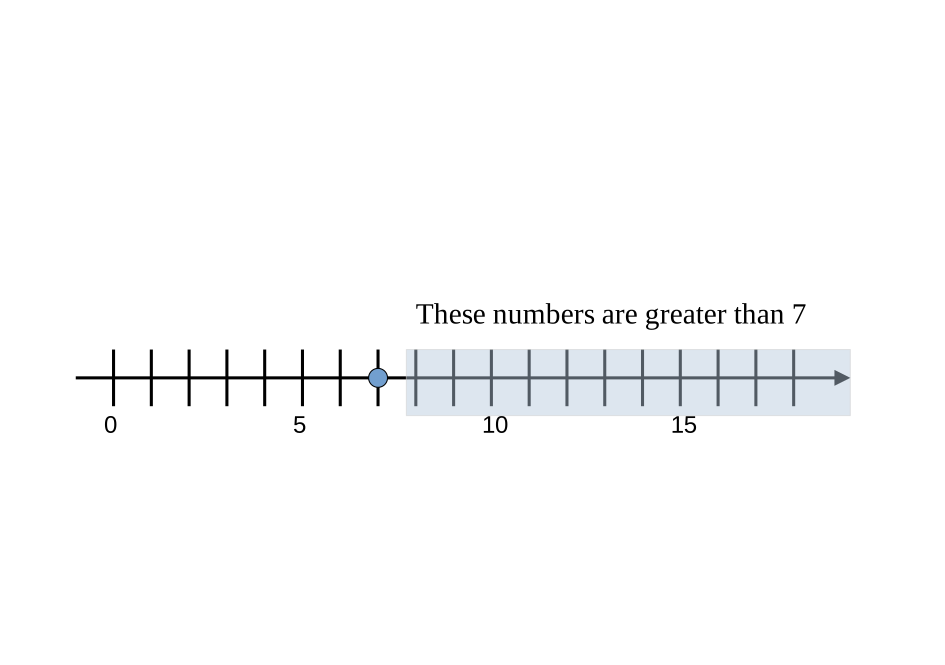
You probably drew a diagram that shows either the set model of addition or the number line model, maybe something like the following if \(a=7\text{:}\)
Solution 2.
The key to this is realizing I can add a (non-zero) counting number to 7 to get 11. In our case it is 4. So we can say that \(7 > 4\) since we found the number 4 such that \(11=7+4\text{.}\)
Solution 3.
We can apply the exact same logic to this problem; the only thing different are the numbers! So we can say \(15 > 3\) since there is a number (12) where \(15 = 3 + 12\text{.}\)
Solution 4.
The key thing to realize is that all that matters is the *existence* of a number, say \(c\text{,}\) such that \(a=b+c\text{.}\) Thus we can write this as a conditional statement:
If \(a > b\) then there is a \(c \in \mathbb{N}\) such that \(a=b+c\text{.}\)

Checkpoint 3.2.4.

In the previous exercise, we developed a definition for "greater than". Modify this definition to define
  1. "greater than or equal to"
  2. "less than"
  3. "less than or equal to"
Now that we have the idea of comparing numbers, we can develop a definition of subtraction of whole numbers. Before looking at the definition, see if you can take the "greater than or equal to" definition and modify it to a definition for subtraction.

Definition 3.2.5.

Let \(a,b \in \mathbb{N}_0\) where \(a \geq b\text{.}\) Then we define the subtraction \(a-b\) to be the unique \(c \in \mathbb{N}_0\) such that \(a=b+c\text{.}\)
Note that this \(c\) is the same number \(c\) in the definition for "greater than or equal to". And we wanted the set to include zero since we want to be able to subtract 0, or have an answer of 0. We will get into subtraction with negative answers when we talk about integers in a later section.

Example 3.2.6.

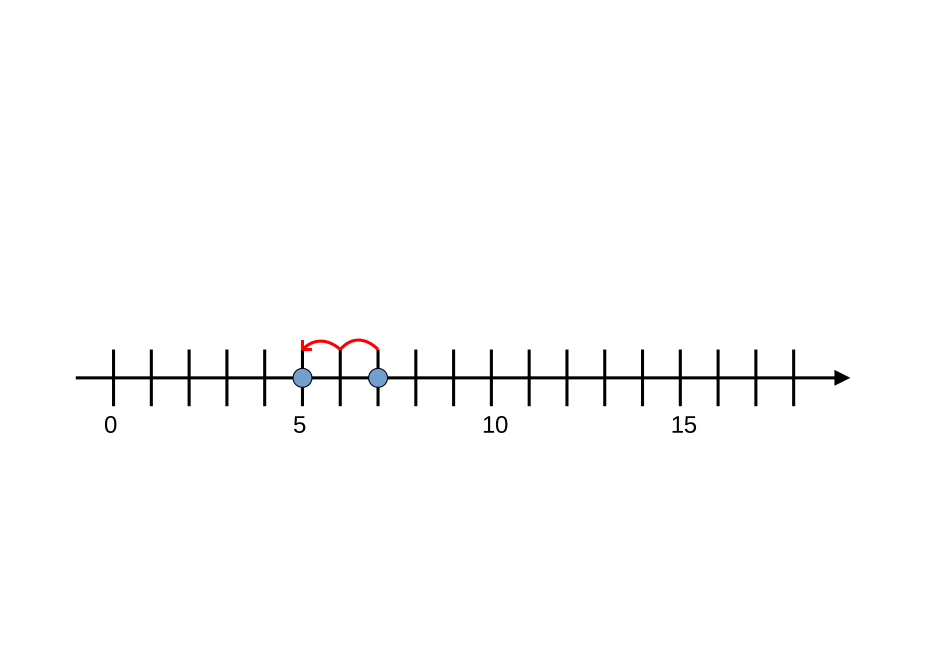
Let’s let \(a=7\) and \(b=2\text{.}\) Since \(7 > 2\) we can talk about \(7-2\) using our definition. We know \(7-2=5\) since \(5\) is the unique number such that \(7=2+5\text{.}\) So in the definition above, we have that \(c=5\) We can view this subtraction via the following diagram.
It’s important to note that we cannot talk about the problem \(2-7\) using our definition above, since \(2 \not\geq 7\text{.}\) We will have to modify our definition later, once we introduce negative numbers.

Example 3.2.7.

Now let’s let \(a=14\) and \(b=0\text{.}\) Then \(14-0=14\) since \(14=0+14\text{.}\) So in the definition above \(c=14\text{.}\)

Subsubsection 3.2.2.1 Related Subtraction Problems

Subtraction problems are often connected in useful ways. For example, if we know that \(a - b = c\text{,}\) then we can also conclude that \(a - c = b\text{.}\) In fact, these two statements are logically equivalent. That is, \(a - b = c\) if and only if \(a - c = b\text{.}\)
This biconditional tells us that a single subtraction fact always gives us a second, related subtraction fact. For example, if \(9 - 4 = 5\text{,}\) then we also know that \(9 - 5 = 4\text{.}\) Thinking in this way can make subtraction facts easier to remember, since each one automatically provides a pair.
Both of these subtraction facts are also tied to the corresponding addition fact \(4 + 5 = 9\text{.}\) In general, if \(a - b = c\text{,}\) then the associated addition problem is \(b + c = a\text{.}\) The two subtractions and the addition all express the same relationship among the three numbers, just in different ways.
Notice that this relationship is different from addition facts, where one equation such as \(4 + 5 = 9\) already contains its “partner” fact \(5 + 4 = 9\text{.}\) Subtraction requires us to be more careful, and the biconditional \(a - b = c\) if and only if \(a - c = b\) makes the connection precise, while the related addition fact \(b + c = a\) ties them all together.
Checkpoint 3.2.8.
How can you express the two related subtraction problems above in terms of inequalities?

Subsection 3.2.3 Multiplication

There are many ways to think about multiplication, but one of the most common is to think of it as repeated addition. That way, we can define multiplication in a way that uses a concept that we have already talked about, namely addition.

Definition 3.2.9.

Let \(a,b \in \mathbb{N}_0\text{.}\) We define \(a \times b\) to be \(a\) copies of \(b\) added together. In the case where either \(a=0\) or \(b=0\) we define \(a \times b\) to be \(0\text{.}\)
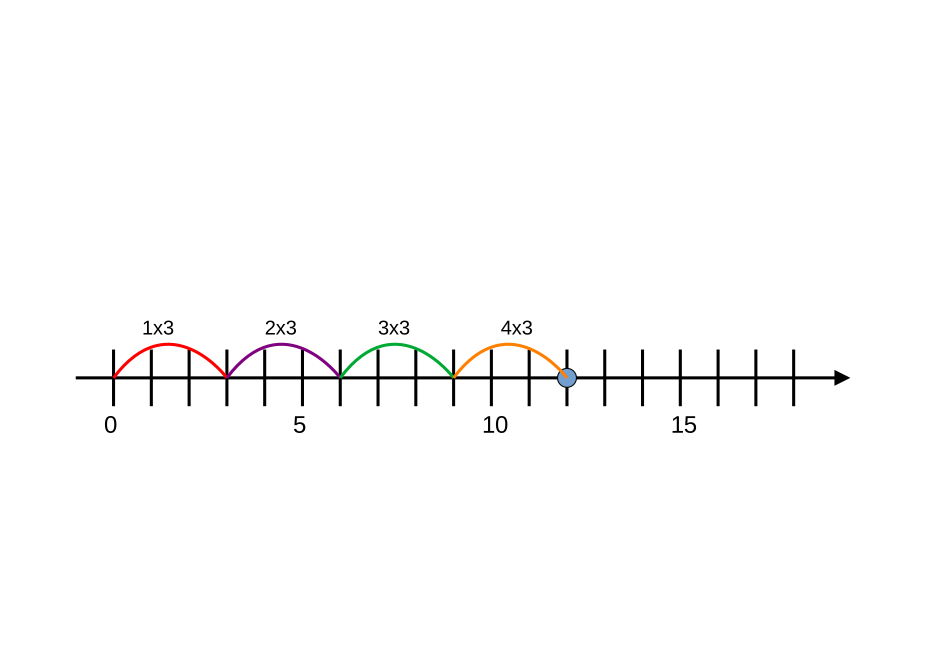
We can view this repeated addition. Consider the example \(4 \times 3\) in the following diagram.
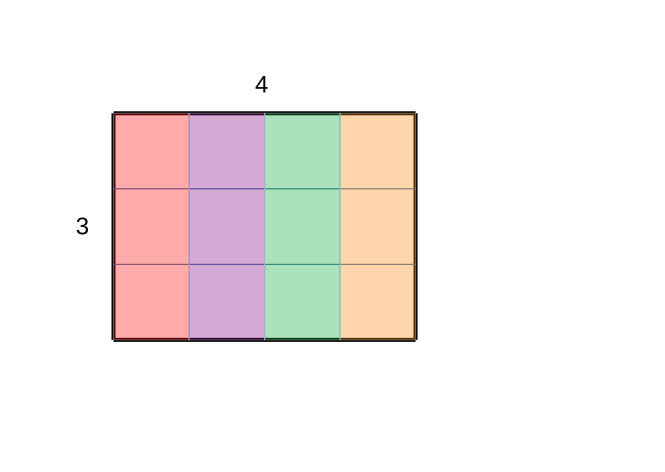
Another way of viewing the multiplication \(a \times b\) is as an area or array. Really, this idea is very similar to the number line model, except each group of \(b\) is directly to the right of the first group. Later, we will see that this model is an excellent one for thinking about multiplication of fractions and decimals too.
Again, let’s model \(4 \times 3\text{:}\)
Area model for 4 times 3

Subsubsection 3.2.3.1 Exponents

MOVE SECTION TO AFTER PROPERTIES OF ARITHMETIC Just like how multiplication is a nice way of writing repeated addition, it’s very useful to be able to have the idea of repeated multiplication. To write \(a \times a \times a \times \ldots \times a\text{,}\) where \(a\) is multiplied by itself \(b\) times, we write \(a^b\text{,}\) where we call \(a\) the base and \(b\) the exponent.
Example 3.2.10.
We can write \(4 \times 4 \times 4\) as \(4^3\) since \(4\) is multiplied by itself \(3\) times.
It’s clear that for any whole number \(a\) we have \(0^a=0\text{.}\) Also, for any whole number \(a\) we say \(a^1 = a\) and if \(a \neq 0\) we say \(a^0=1\text{.}\) Note that we leave \(0^0\) undefined; as this causes a lot of trouble if we try and give this meaning. We will see why later.
Let’s try and come up with some rules for multiplying exponents. What if we wanted to multiply \(3^2 \times 3^4? \) We could write
\begin{equation*} \quad 3^2 \times 3^4 = (3 \times 3) \times (3 \times 3 \times 3 \times 3). = (3 \times 3 \times 3 \times 3 \times 3 \times 3) = 3^6 \end{equation*}

Subsection 3.2.4 Division with Remainders

Subsubsection 3.2.4.1 Introduction To Division

Now that we have the idea of multiplication as repeated addition, we can view its inverse operation, division, as repeated subtraction.
First, an example to see what we mean:
Example 3.2.11.
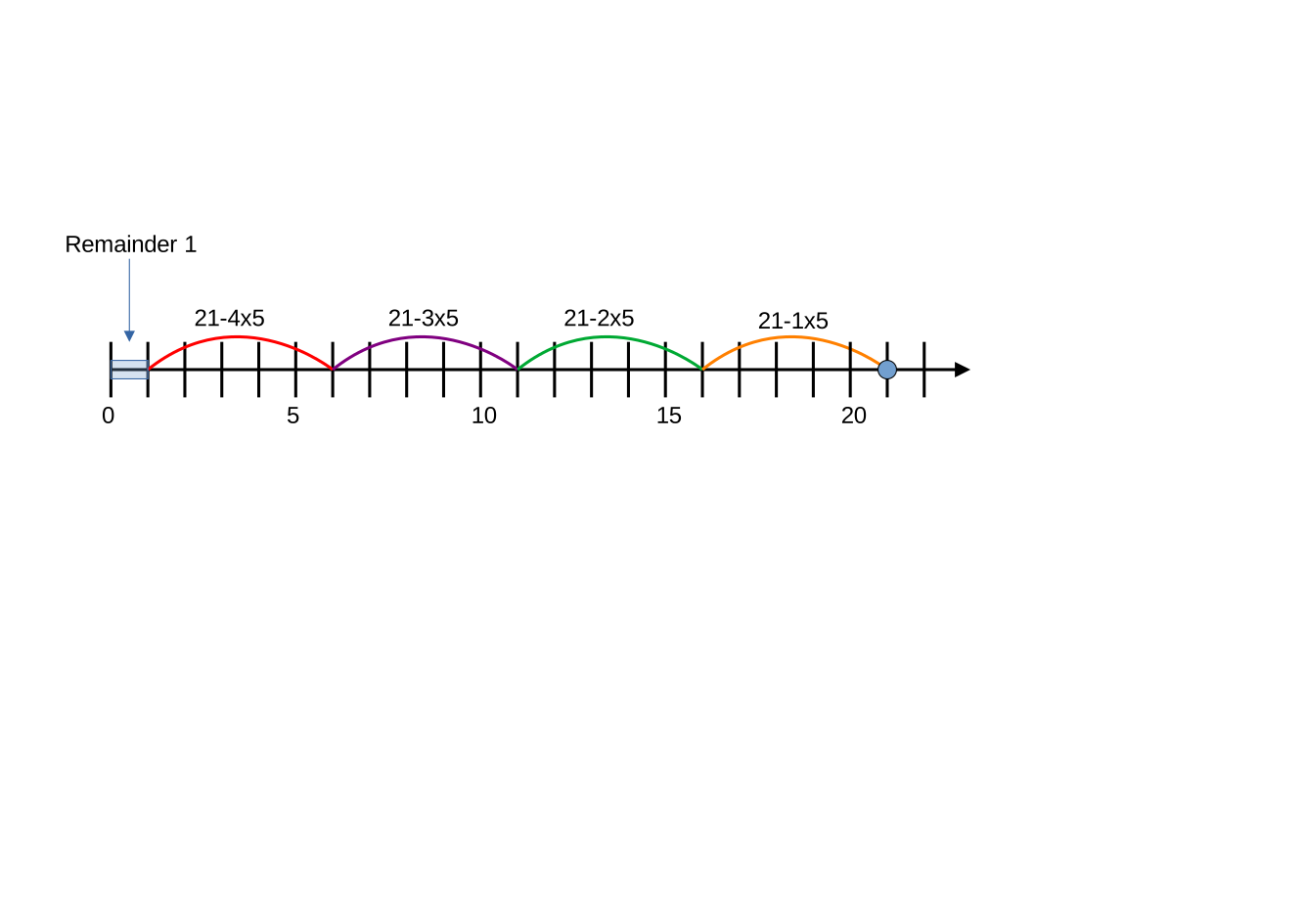
Let’s say we wanted to do the division problem \(21 \div 5.\) We can view this as counting the number of times we can subtract 5 from 21 until we’re unable to anymore (without going in to negative numbers). We know
\begin{equation*} 21-5=16 \end{equation*}
\begin{equation*} 16-5=11 \end{equation*}
\begin{equation*} 11-5=6 \end{equation*}
\begin{equation*} 6-5=1 \end{equation*}
and since 1 is less than 5 we cannot subtract 5 from 1 using our definition of subtraction. We were able to subtract 5 four times from 21, so we say that \(21 \div 5 = 4 \ R \ 1\) since there is 1 remaining at the end of this repeated subtraction. Let’s look at this in general:
Definition 3.2.12.
Let \(a,b, q, r\in \mathbb{N}_0\) with \(b \neq 0\text{.}\) Then we say that \(a \div b = q \ R \ r\) if and only if there are unique numbers \(q\) and \(r\) where \(a = q \times b+r\) and \(0 \leq r \leq (b-1)\text{.}\)
We call \(a\) the dividend, \(b\) the divisor, \(q\) the quotient, and \(r\) the remainder. As \(b \neq 0\) is part of this definition, we say the expression \(a \div 0\) is undefined; that is, the concept of division isn’t defined when \(b = 0\text{.}\)
Note just like us defining subtraction in terms of something we already knew, we defined division in terms of multiplication and addition. So we’re on solid footing here; if we ever forget what division means, we just look up this definition which is in terms of multiplication and addition, which, if we forget, we can look up the definition of those too. This seems like it’s overkill for such simple concepts (and it is in a way) but this is how mathematicians think about concepts so it’s good practice to do this for easy and intuitive ideas like arithmetic.
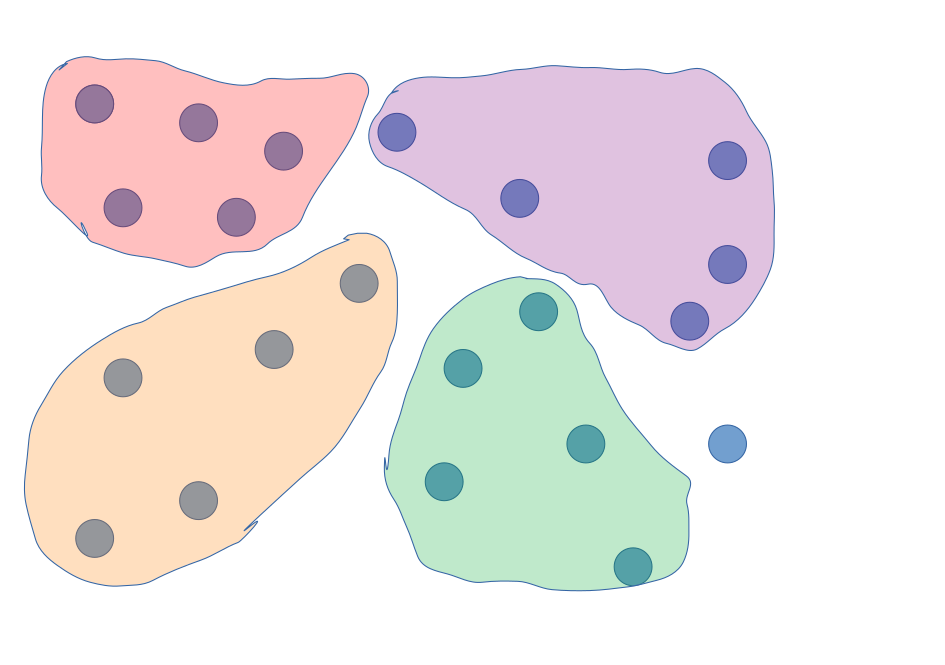
We can also view the division \(a \div b\) as the number of groups with \(b\) elements you can make out of \(a\) objects. This is called the measurement model of division. Let’s look at \(21 \div 5\text{.}\)
The division \(a \div b\) can be viewed in another way as well; we can ask if we wish to partition \(a\) objects into \(b\) groups, how many objects are in each group? This is called the partitive model of division (the word "partitive" being related to the idea of a partition). Again, we look at \(21 \div 5\) using this model
Checkpoint 3.2.13.
Which of the following is viewing division using the measurement model, and which is viewing division using the partitive model?
  1. You wish to divide \(43\) students into \(4\) equal sized groups? How many students are in each group, and how many students are left over?
  2. You wish to divide \(43\) students into groups of size \(4\text{.}\) How many groups can you make, and how many students are left over?
Solution 1.
This is partitive, since the size of the groups is unknown, but the number of groups is fixed.
Solution 2.
This is measurement, since the size of the groups is fixed, but the number of groups is unknown.
Notes for Additional Understanding.
It’s intuitive that every division problem \(a \div b\) has one answer, that is one quotient \(q\) and remainder \(r\) that make the equation \(a=qb+r\) true. However, this is something that really needs to be proved before we can say it for sure. We will revisit this in the section where we talk about divisibility of numbers.