Section 4.4 Division Algorithms

In this section, we will predominantly talk about only one algorithm, commonly called long division. We will talk about a few other algorithms that are minor variations of the well known long division.

Subsection 4.4.1 Long Division

Consider the division problem \(a \div b\) where \(a,b \in \mathbb{N}.\) The idea behind long division uses the partitive mode of division along with the idea of place value. Starting with the largest place value of the dividend \(a\text{,}\) we group as many of those place into \(b\) groups. Any of that place value remaining we ungroup into the next largest place value. A quick note: remember from the Quotient Remainder Theorem that remainders are always between \(0\) and \(b-1\) (inclusive) so we know each remainder in our calculation, which we will call a place remainder, must be within this range. Let’s write the above as an algorithm:
  1. Write the division \(a \div b\) with the dividend \(a\) under the "long division" symbol, and the divisor \(b\) directly to the left.
  2. Starting with the largest place value in \(a\text{,}\) group as many of that place as possible evenly into \(b\) groups. Write the number in each group above the place value you are working with (we call this the partial quotient of the place). Note that you may have some of that place value remaining.
  3. Subtract the number you were able to group from the total of that place value to determine your place remainder. Do this subtraction below the dividend.
  4. If the current place value is the ones place, you have finished. The remaining ones are your \(remainder\) for the calculation, and the number above the dividend is the \(quotient\text{.}\) Otherwise, ungroup the place remainder into the next place value to the right and add these to the place to the right. Go to Step 2.
Let’s do an example to see how this works.

Example 4.4.1.

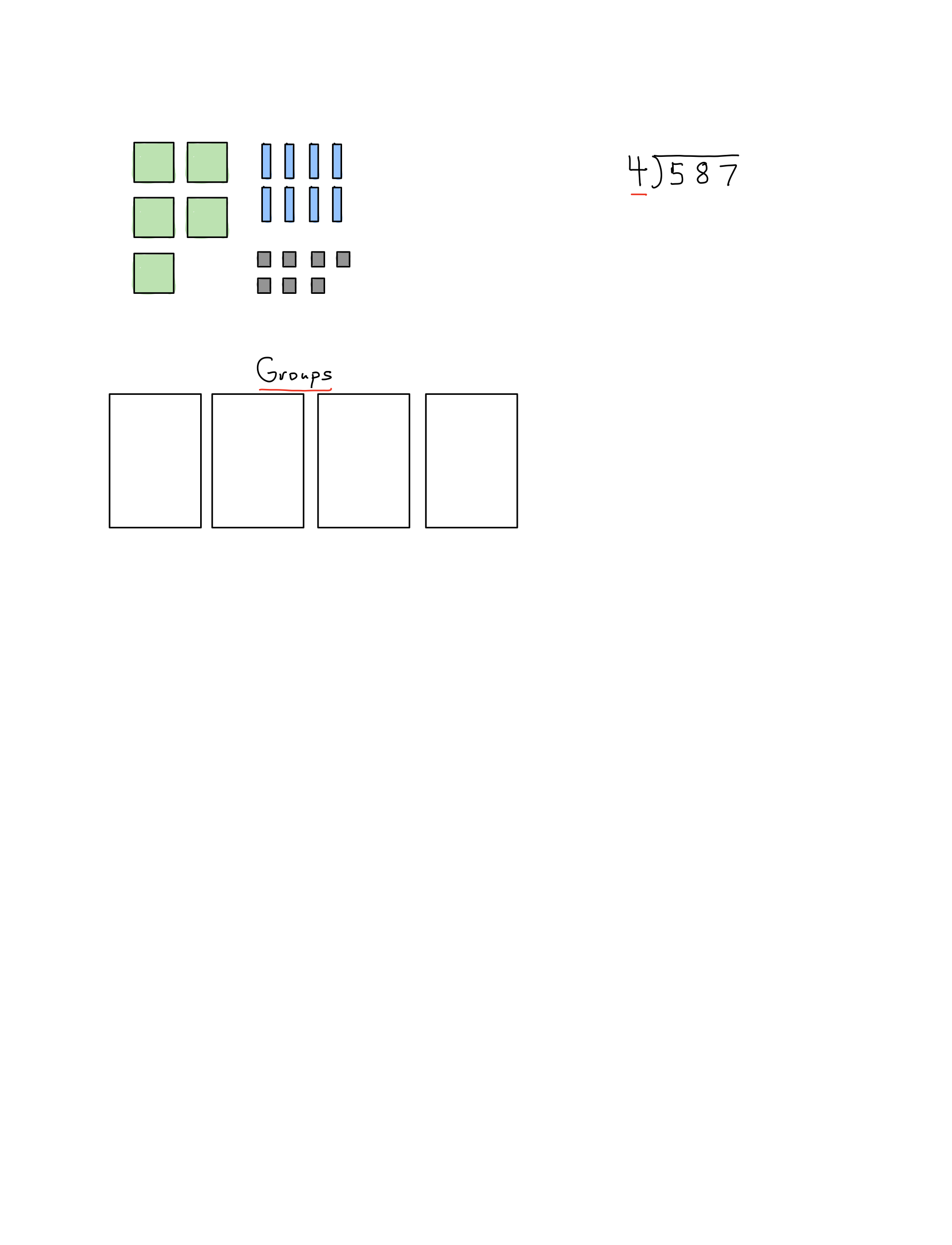
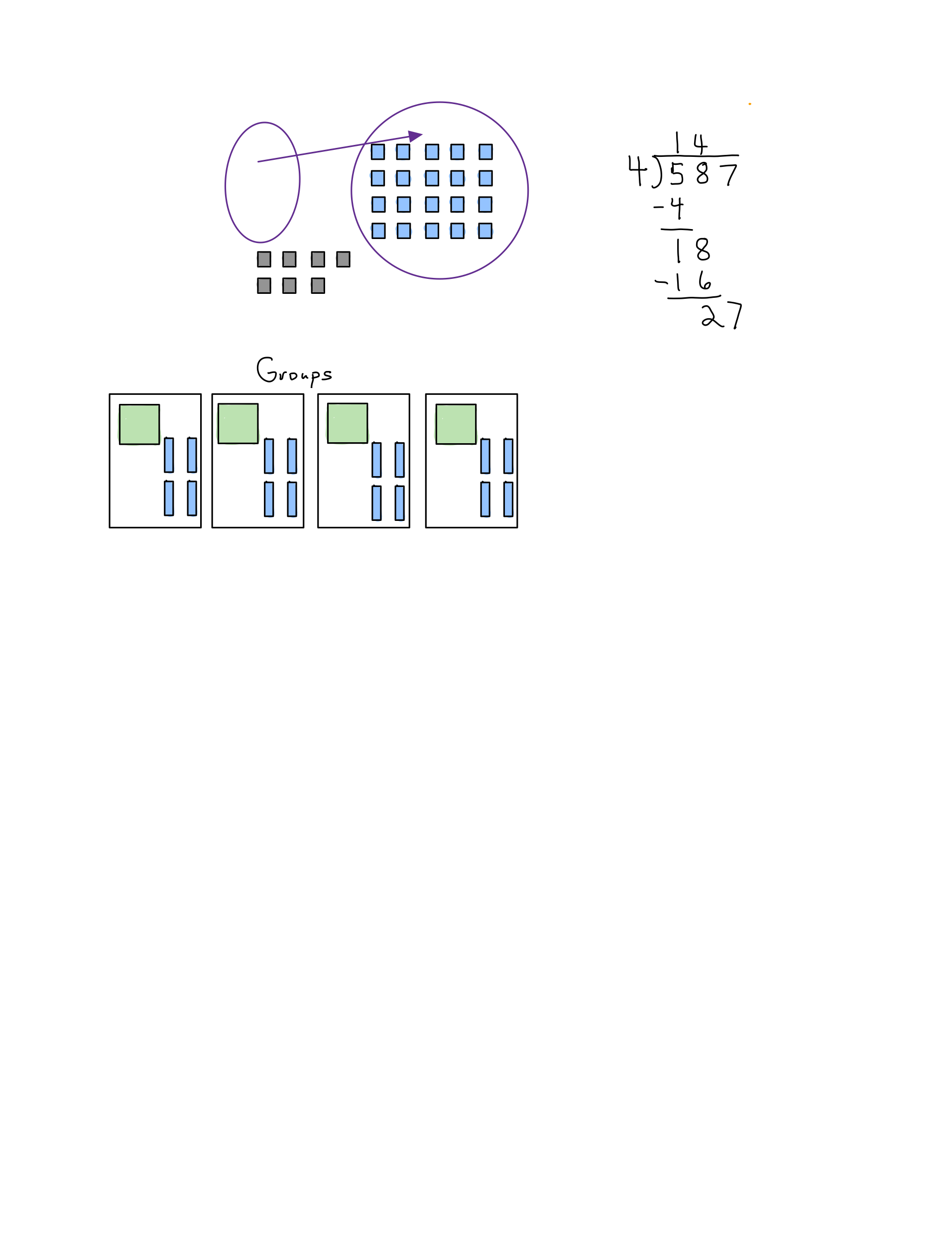
Let’s do the calculation \(587 \div 4\text{.}\) We write this using the long division symbol. We think of \(4\) as the number of groups we are making (using the partitive model of division).
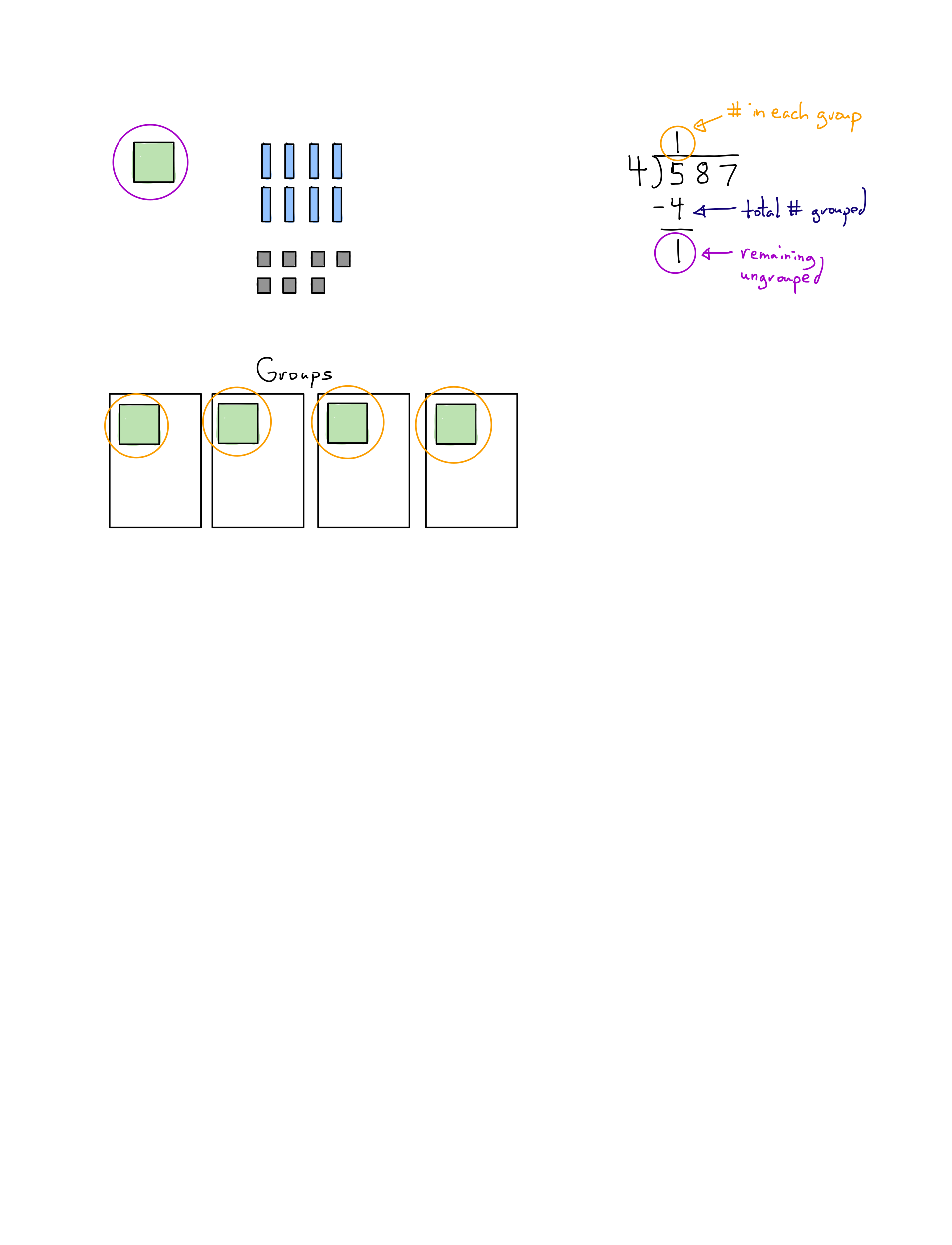
Starting with the hundreds place, we find that we can group at most one hundred evenly into each of our four groups. We note this in the quotient by putting a \(1\) in the hundreds place. We have \(5-4=1\) hundred remaining.
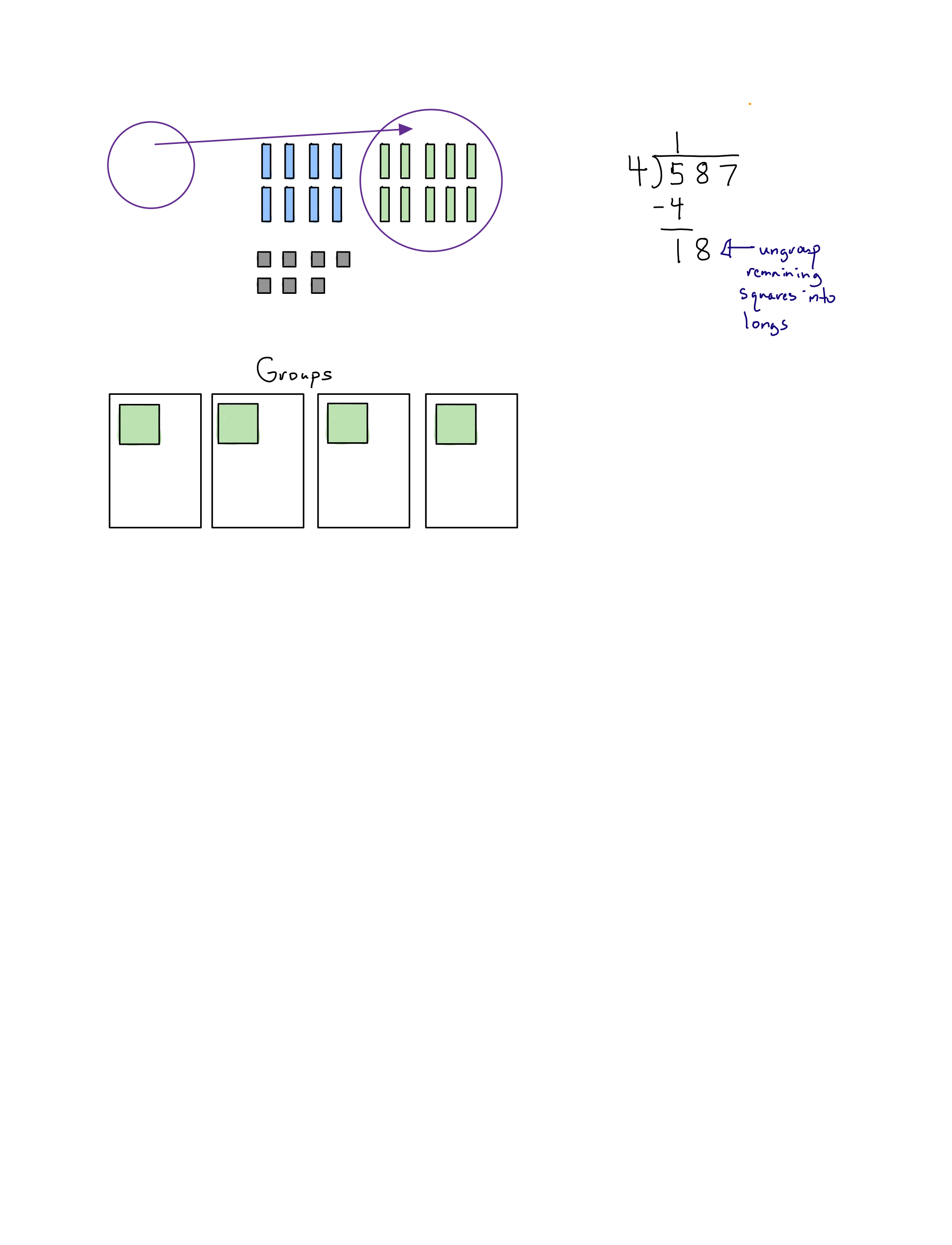
Now we "ungroup" our one hundred into 10 tens, giving us \(10+8=18\) tens. We note this in our calculation by "bringing down" the \(8\) tens in the dividend.
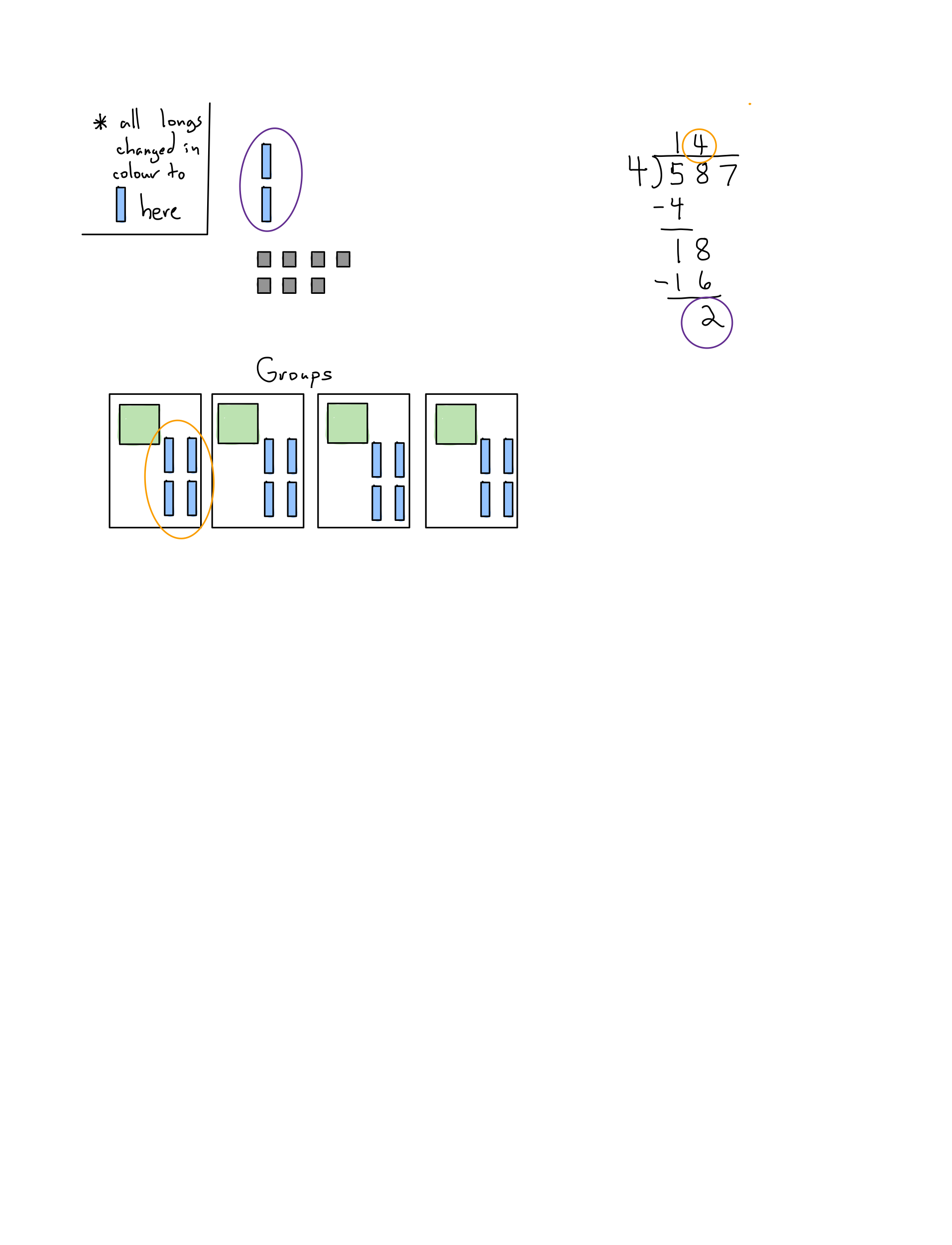
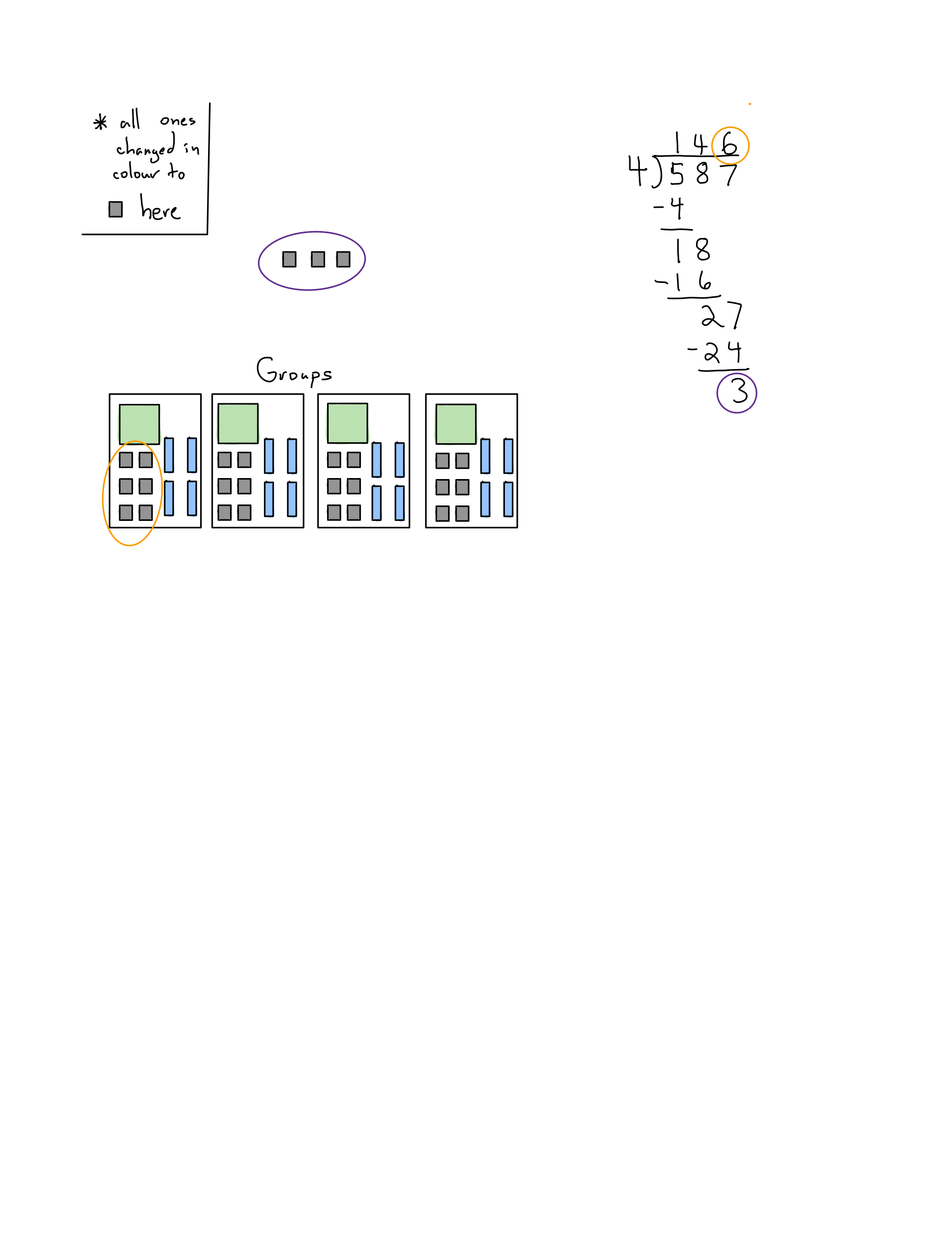
Now, we can evenly divide our \(18\) tens so that \(4\) are in each group, with \(2\) tens remaining (since \(18=4 \times 4 +2\text{,}\) or \(18 \div 4 = 4R2\text{.}\)) We write the \(4\) in the tens place of the quotient, and we have \(18-4 \times 4=18-16=2\) tens remaining. We write this down in our calculation.
We "ungroup" the \(2\) tens into \(20\) ones giving us \(20+7 = 27 \) ones. We write this in our calculation.
Finally, we can divide our \(27\) ones so that \(6\) are in each group of \(4\text{.}\) We write this in our quotient and since \(27 \div 4 = 6R3\) we have \(3\) ones remaining. Since we are at the ones place we are finished our calculation, and thus \(587 \div 4 = 146R3\text{.}\) Each group of \(4\) contains \(146\) with \(3\) ones unable to be grouped evenly.
It may be the case that our divisor \(b\) is not a single digit. In these cases, we don’t usually know our "\(b\) times tables" but we can use our estimation and trial-and-error skills to determine the correct number of places in each group. Let’s do a quick example to see this in action:

Example 4.4.2.

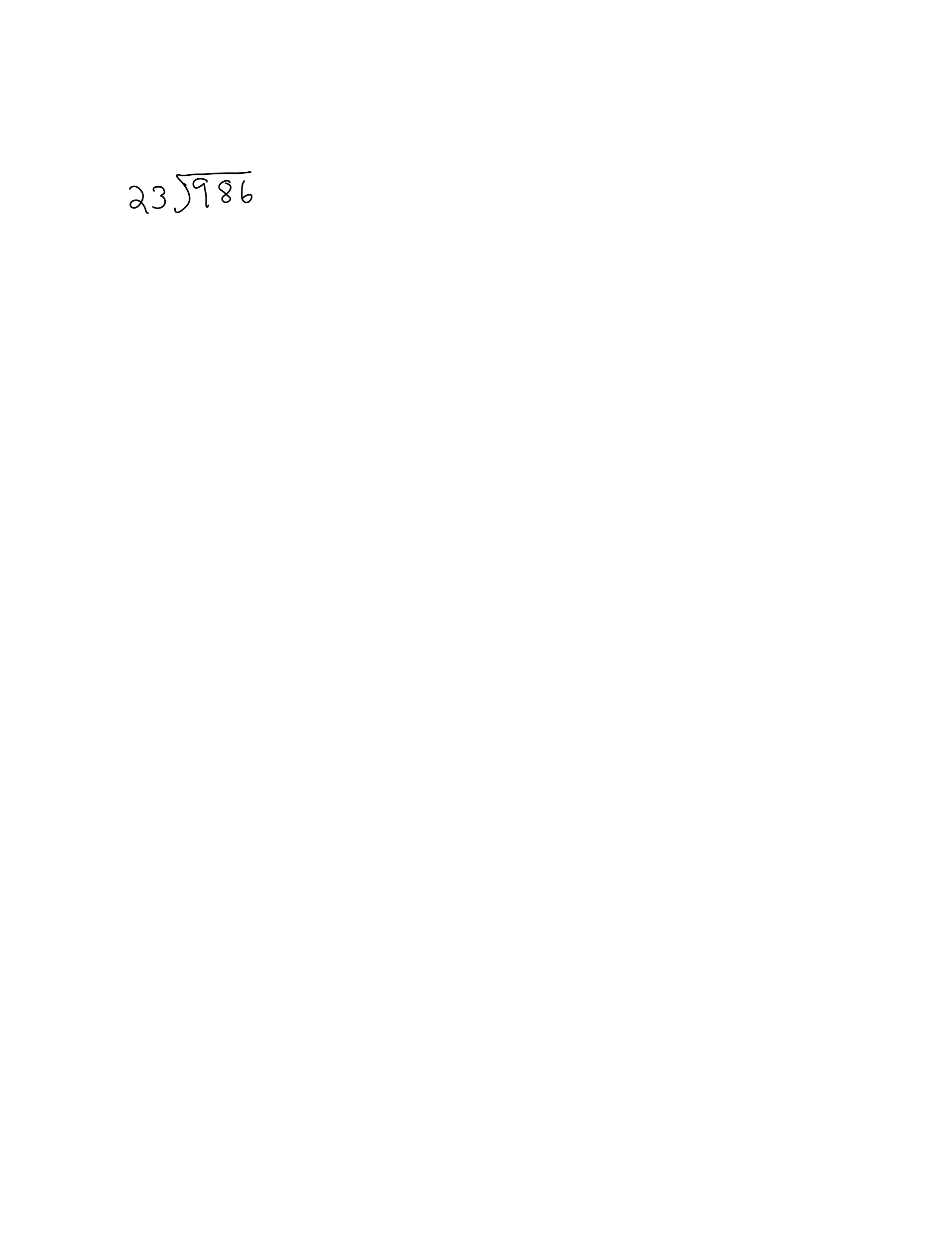
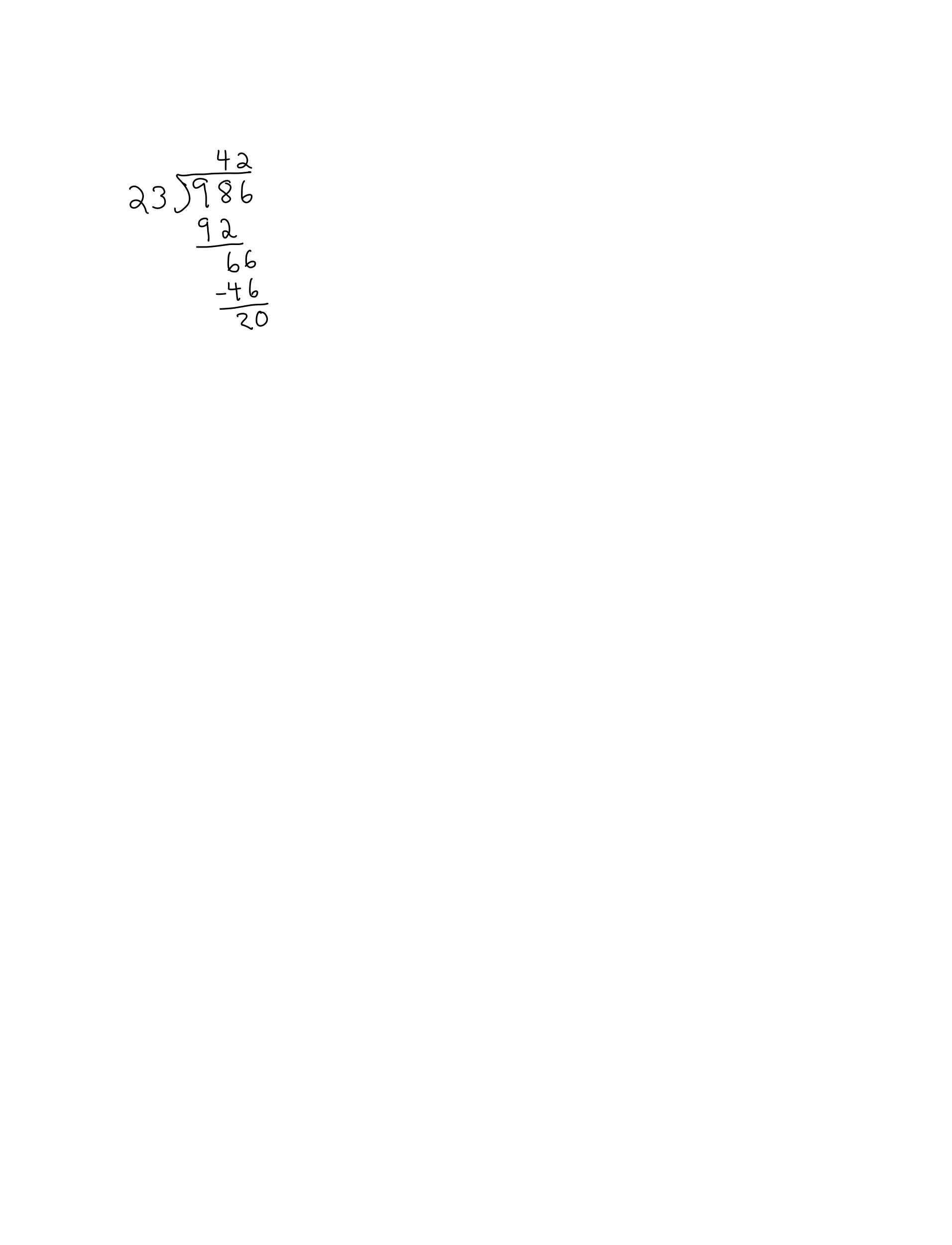
Let’s do \(986 \div 23\text{.}\) Now, we don’t know our \(23\) times tables, so we are going to have to estimate. Let’s write our calculation in the correct long division form, and note that we won’t include the block representation here, but it is worth using this representation if we need some visual guidance:
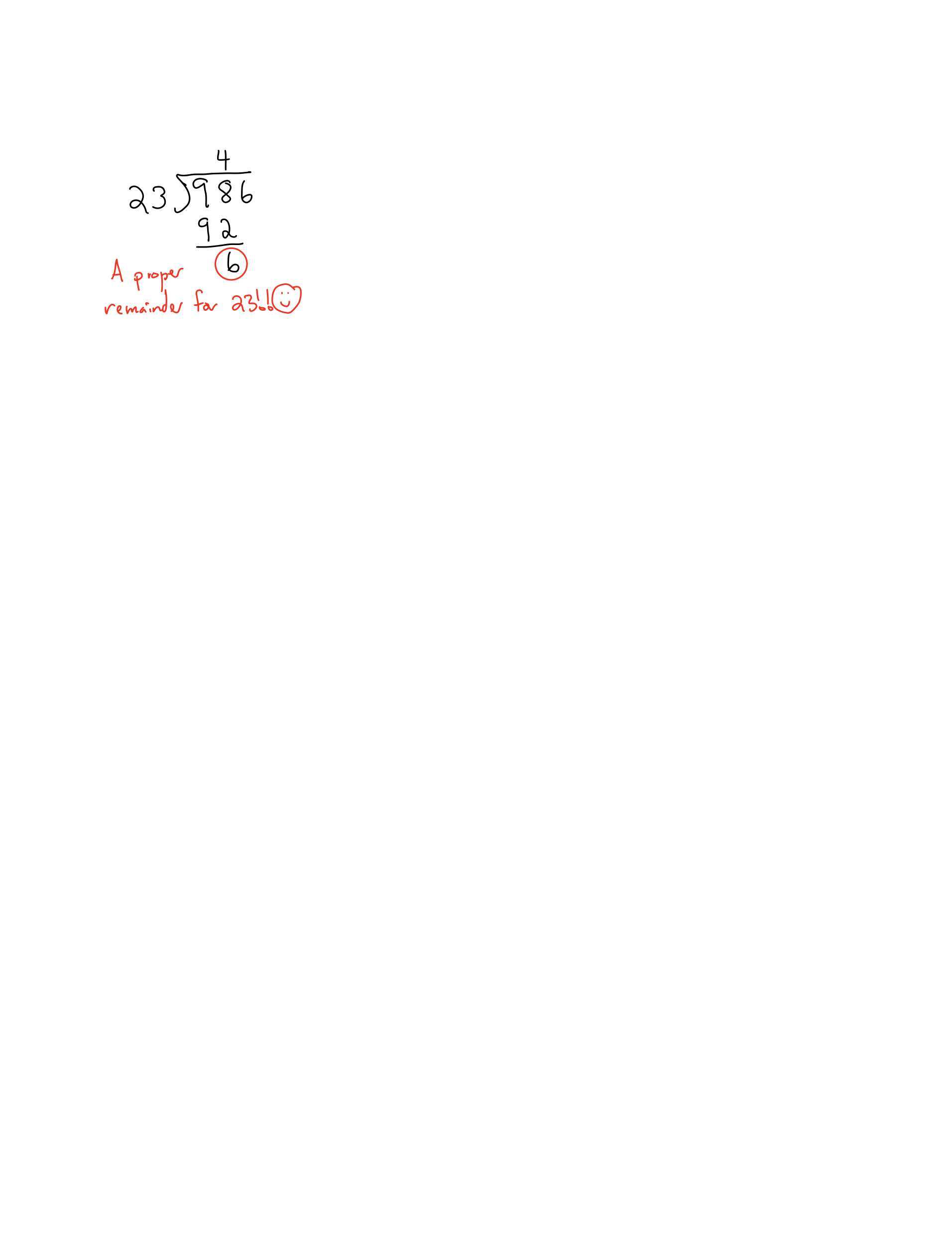
Now, we know that we cannot group \(9\) hundreds evenly among \(23\) groups, so we ungroup these into tens, giving us \(94\) tens in total. We know that \(23\) is close to \(20\text{,}\) so we can use multiples of \(20\) as an estimation for the correct hundreds quotient. We know \(4 \times 20 = 80\) and \(5 \times 20 = 100\text{,}\) so let’s see if we can put at most \(4\) tens evenly in each of our \(23\) groups: \(4 \times 23 = 92\) and \(5 \times 23 = 115\text{,}\) so \(4\) is the correct partial quotient. Subtracting, we find that we have a remainder of \(6\text{.}\)
Ungrouping these \(6\) tens into ones gives us \(66\) ones in total. Using a similar procedure to before, we find that \(2 \times 23 = 46\) and \(3 \times 23 = 69\) so our ones quotient is \(2\) with a remainder of \(66-46=20\text{.}\)
Thus we have calculated that \(986 \div 23 = 42R20\text{.}\)

Subsection 4.4.2 Long Division Base Twelve

Just like our other algorithms, we can perform division in any base we like. Let’s do an example in base twelve. For this section, all numbers will be in base twelve even without the subscript indicating so, though sometimes it will be included for clarity.

Example 4.4.3.

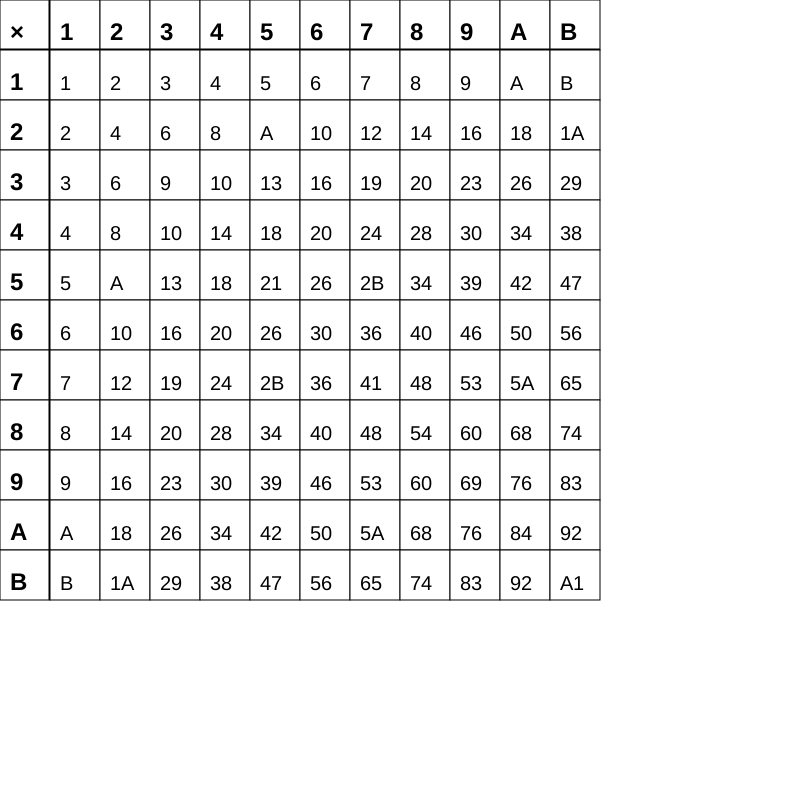
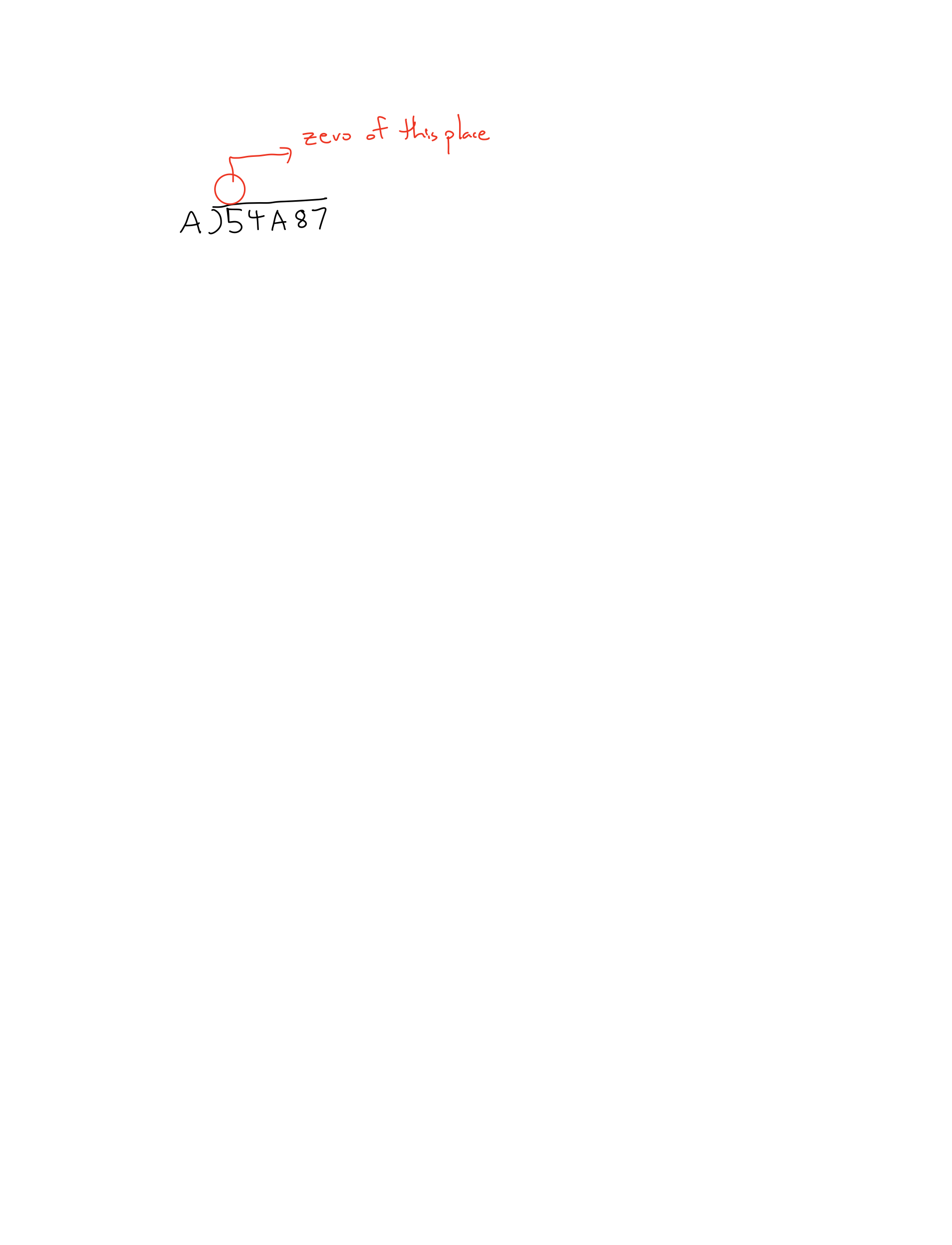
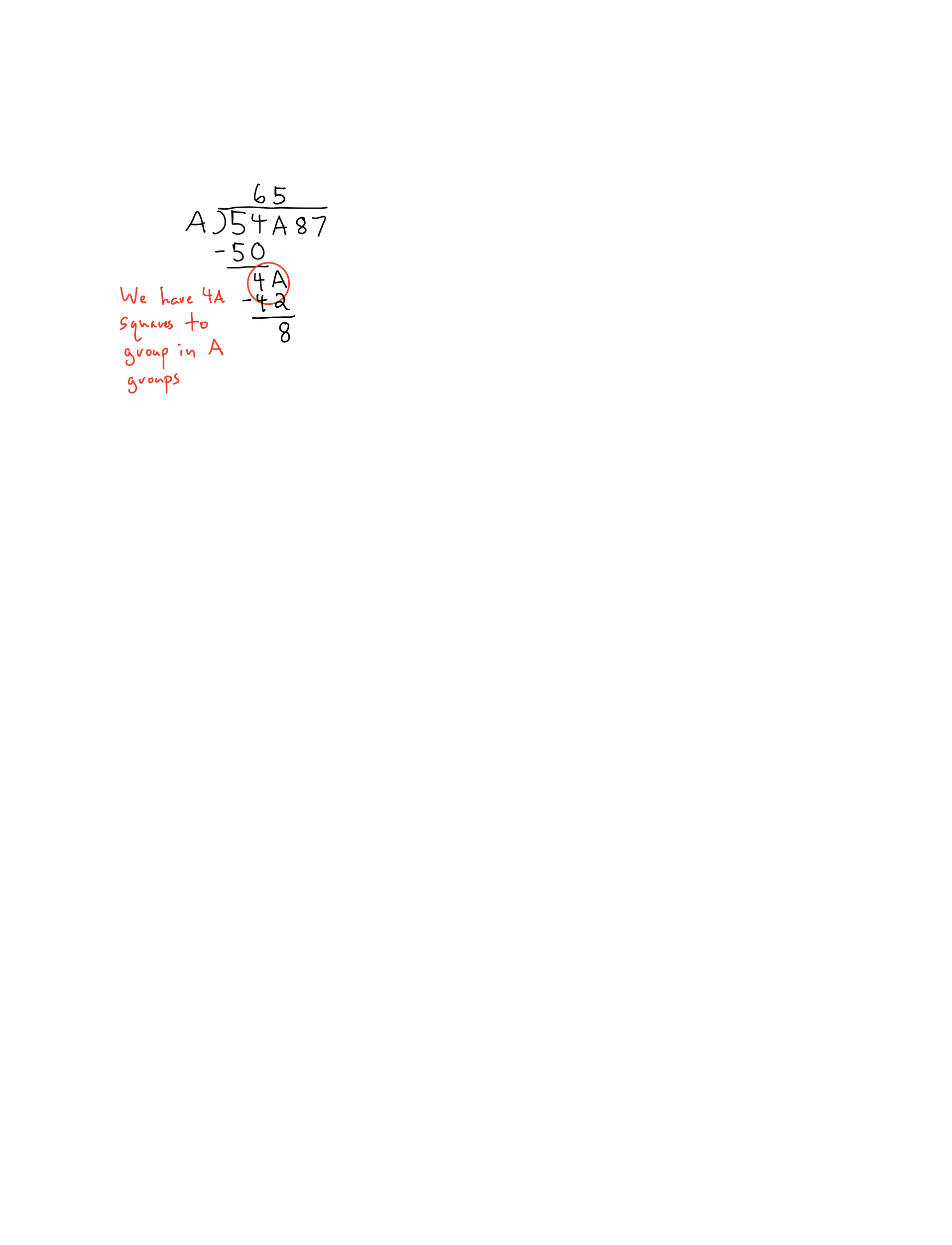
Let’s do the base twelve division computation \(54A87 \div A.\text{.}\) Remember here that \(A\) is our symbol for "ten". Our base twelve multiplication table will help a lot, so we include it here for easy reference:
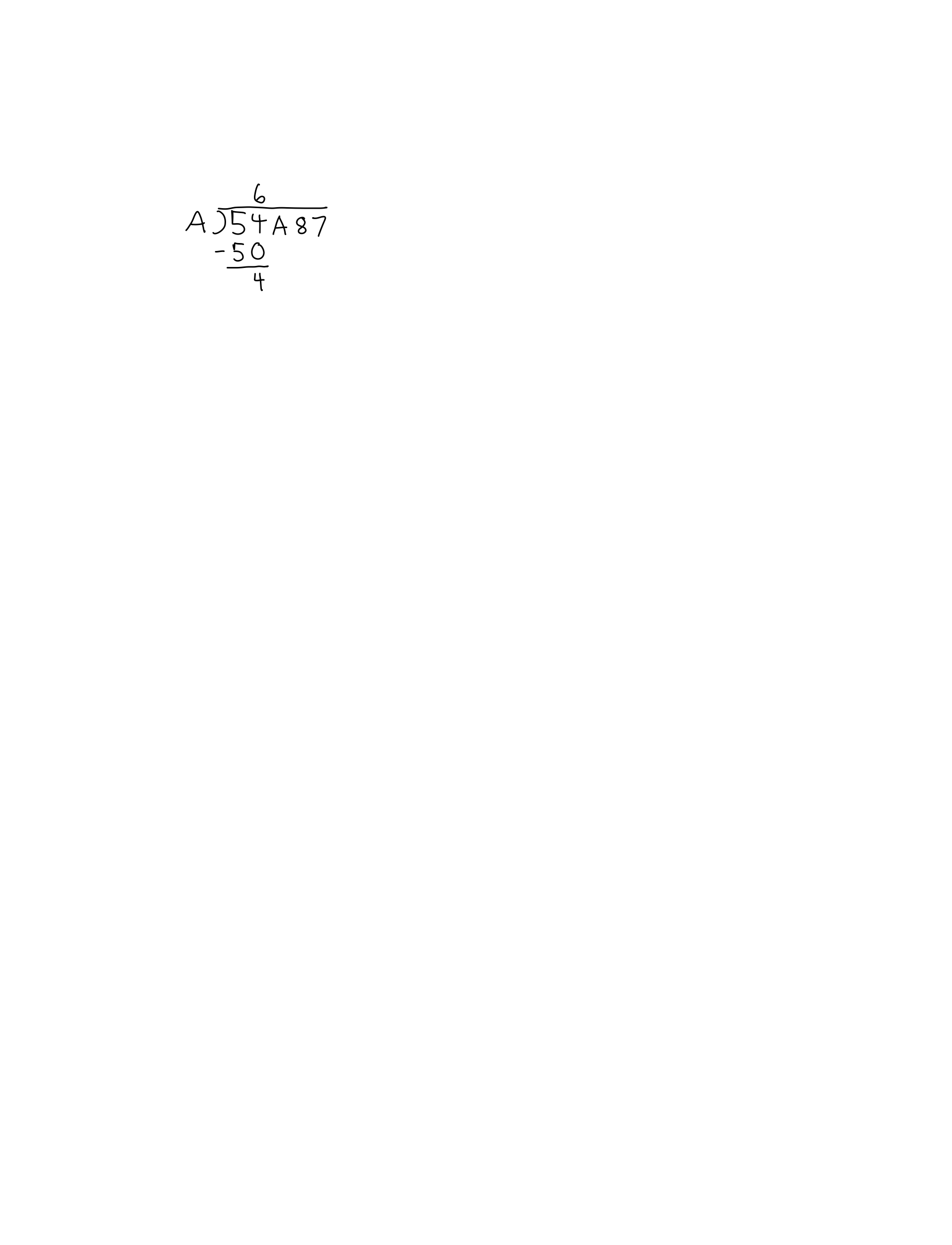
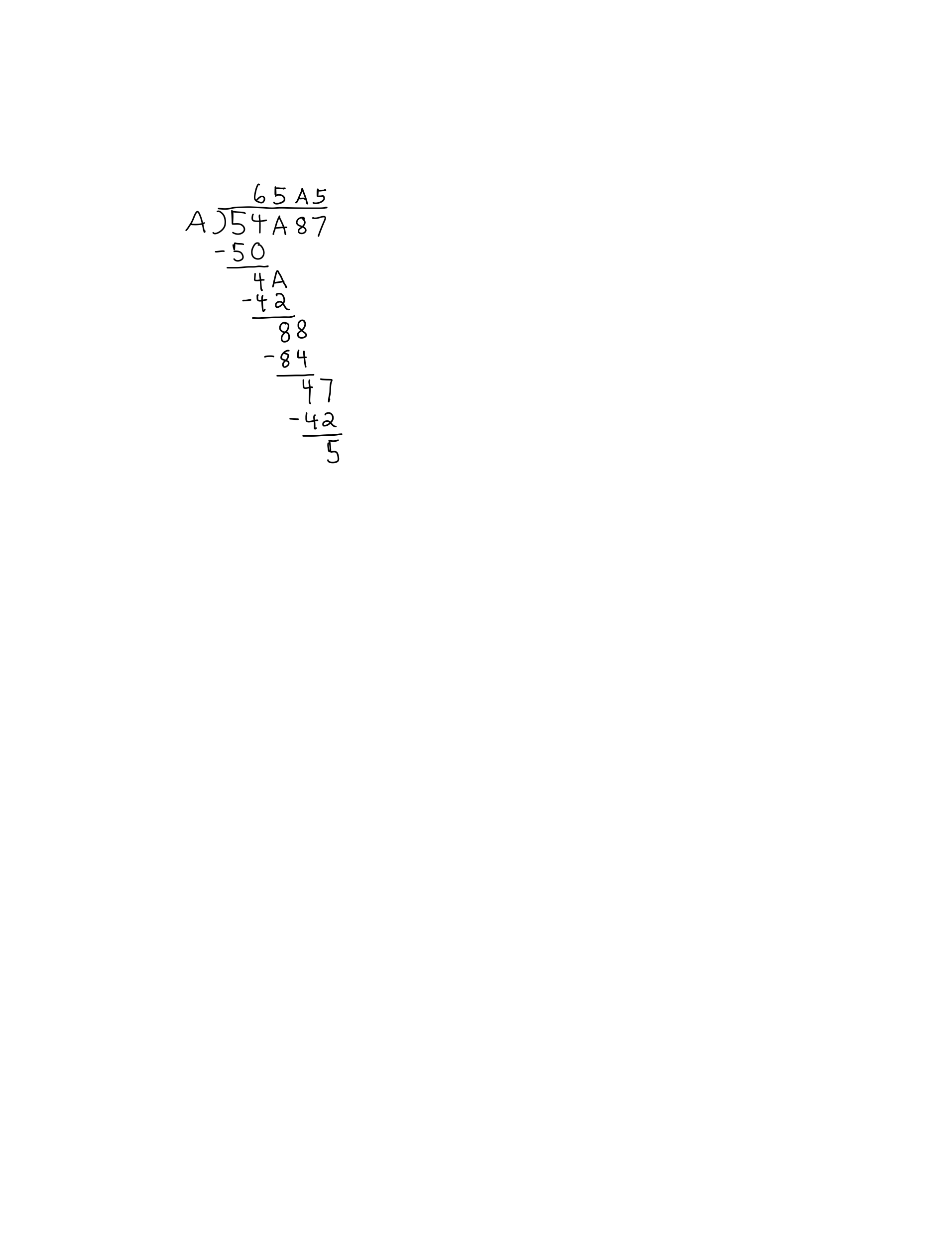
We write down our dividend and divisor in the appropriate locations. Now we perform the algorithm. We start at the \(10^4_{twelve}\) place (a long made of cubes) and ask "if we have 5 of this place, how many can be evenly divided among ten groups." We do not have enough to put any in the groups, so we put a zero in the quotient above this place (however, we don’t need to explicitly write it since we do not write whole numbers starting with a zero). We have grouped \(0 \times A = 0 \) of this place, and have \(5-0=0\) remaining.
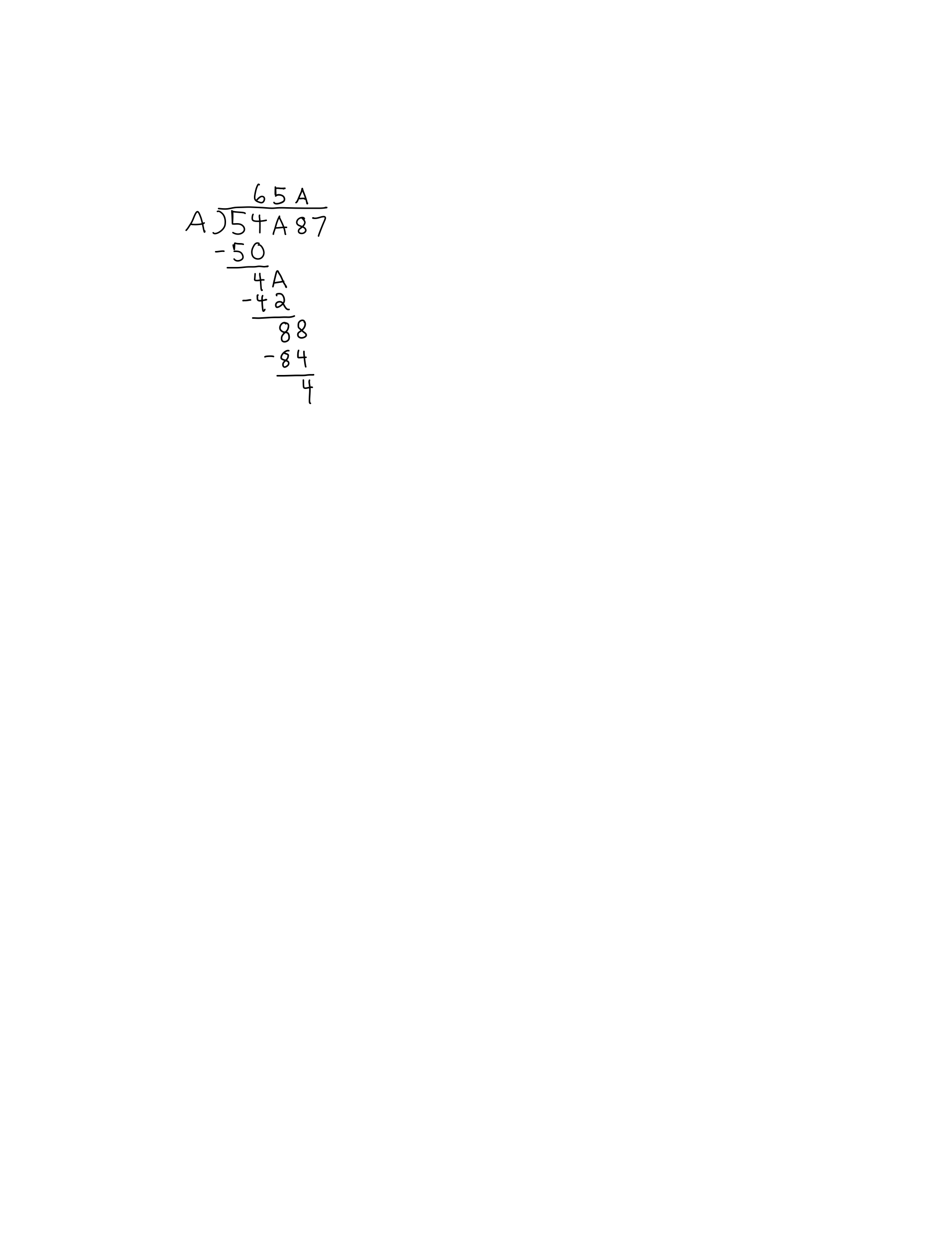
Each of this place can be ungrouped to twelve (that is \(10_{twelve}\)) of the place to the right. So we ungroup these to have \(5 \times 10 + 4 = 54\) of the next place value, which is \(10^3_{twelve}\) (that is, cubes). Similarly we ask "if we have \(54_{twelve}\) of this place, how many can be evenly divided among ten groups?" Using our multiplication table we see that \(6 \times A = 50\) and \(7 \times A = 5A\) thus the most we can put in our groups is \(6\) cubes. Thus we have grouped \(6 \times A = 50\) and have \(54-50 = 4\) cubes remaining.
We now ungroup these \(4\) cubes into forty-eight, or \(40_{twelve}\) squares and add these to the \(A\) squares we originally have. Similarly, since \(5 \times A = 42\) and \(6 \times A = 50\) we know that we can evenly put \(5\) squares in each of our \(A\) groups, and we have \(4A-42=8\) squares remaining.
We ungroup these \(8\) squares to make ninety-six (or \(80_{twelve}\)) longs. Adding our original \(8\) longs we have \(80+8==88\) longs. Similarly to the previous places, we know \(A \times A = 84\) and \(B \times A = 92\) so we can evenly put \(A\) longs in each of our \(A\) groups, and we have \(88-84=4\) remaining.
Finally, we ungroup these \(4\) longs to make \(40_{twelve}\) ones. Adding our original \(7\) ones we have \(47\) ones in total. Since \(5 \times A = 42\) and \(6 \times A = 50\) we know that we can evenly put \(5\) ones in each of our \(A\) groups, and we have \(47-42=5\) remaining. We have reached the ones place, so we are finished. Thus \(54A87 \div A = 65A5R5.\)

Subsection 4.4.3 Short Division

There is another, slightly more encapsulated method of doing division. Essentially it is the same as long division, except we do the subtractions in our head and put the partial remainders above the digit in the place to the right. This gets a bit cumbersome if we have a large divisor (even greater than a single digit divisor can get tricky unless you’re very comfortable with mental arithmetic). However, it’s great for single digit divisors. We call this short division.
Rather than explaining short division in any depth, doing our previous long division problem using short division, along with the preceding explanation, should be instructive enough.

Example 4.4.4.

Let’s do the calculation \(587 \div 4\) using short division. We will simply show the calculation here, and this should be enough to understand once we’re reminded that the "carried" numbers that appear are the partial remainders from long division.
INCLUDE PIC OF LONG AND SHORT DIVISION, CIRCLING THE COMMON REMAINDERS IN BOTH CALCULATIONS